ENGLISH-CHN-2-HEALTH SYSTEM IN INDIA (PART-2)(full course)
💚 Organization and administration of health system in india ( Organization and Administration of Health System in India ):
India is a democratic country consisting of 28 states and eight union territories, which are further divided into districts. And it is divided into talukas. Thus, providing health care in India is very challenging because India has different areas including inaccessible forests, mountains and desert areas and many densely populated areas, so it is a challenge to provide health care to everyone. But since India is a welfare state, the government ensures that every citizen gets basic health services because all these have to work according to the constitutional provisions of India.
💚 Health services organization at different levels ( Health Services Organization at Different Level ):
In India, the organization’s line of authority for health services, i.e. the administratively responsible structure, starts from the national level and extends down to the block. Due to this organization, health services can be provided to the smallest rural areas.
This organization is divided into four phases.
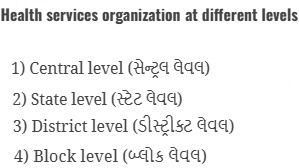
- Central level (Central Level)
- State level
- District level
- Block level
💚 write Principles of organization and administration
👉1. The main responsibilities are of one person but different responsibilities are given for each activity, for example, CHC- MO
👉2. When any work has to be done, the work should be done in coordination with the main authority.
👉3. When working for the prevention of any disease or when providing treatment, there should be coordination of each and every authority.
👉4. Administration should be based on the financial budget with great success.
👉5. If any planning is to be done, its frame work should be carefully prepared and its issues should be prepared (micro plan).
👉6. Provide necessary education to the staff for the program that is being implemented or running. So that the program becomes effective and progressive. For example, pulse polio, IMNCI and IMMUNIZATION.
👉7. It is necessary to know the opinion of the people in every health activity so that proper health education and information can be given to the people and the cooperation of the people can be obtained in health activities.
👉8. The planning of every program should be done on a scientific basis.
👉9. To effectively evaluate the program that is running and know the progress.
👉10. Provide favorable conditions for every member of the health team for the staff.
💚 central level:-
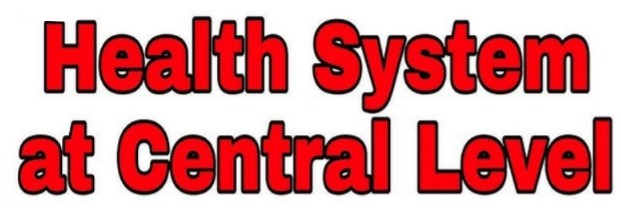
Union Minister of Health and Family Welfare –
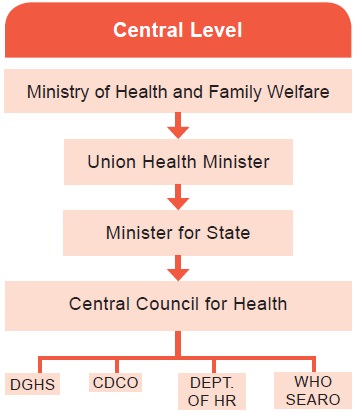
DGHS – Director General of Health Services
CDCO – Central Drugs Control Organisation
HR – Health Research
WHO – World Health Organization
SEARO – South East Asia Regional Office
💚 Responsibility of central health organization or Responsibility of health ministry ( Responsibility of Central Health Organization or Responsibility of Health Ministry)
- Policy making
- Planning
- Guidance
- Co-ordination
- Evaluation
💚 Write Function of health ministry or Function of central level health organization
👉1. To regulate international health and collect information related to it.
👉2. To administer central health institutions, including,
A. All India Institute of Medical Science in Delhi (AIIMS).
B. Post Graduation Institute of Medical Science in Chandigarh.
C. Indian Institute of Hygiene and Public Health in Calcutta.
The Ministry of Health manages all these properly.
👉3. To provide necessary opportunities to advance research, to start research centers and to help them.
👉4. To make efforts to update knowledge in education such as medical education, nursing education, pharmacological branch etc.
👉5. Drugs control, including maintaining the quality of drugs. To regulate it so that it does not get misused and to keep the price of medicines affordable to the people.
👉6. To collect population census and vital statistics and publish necessary information.
👉7. To help in going abroad for educational purpose and to provide necessary scholarship for that.
👉8. To prepare regulations related to labour.
👉9. To plan for implementation of health skill and make necessary amendments in it.
👉10. To take strict steps to prevent communicable diseases.
👉11. Prevention of food adulteration.
👉12. Control of poisonous drugs
👉13. Sanitary control of food
👉14. To help in public health activities.
👉15. Working for health education with the central health bureau in Delhi.
👉16. Collecting and publishing information on vital statistics.
D.G.H.S (Director of general health services)
SUNITA SHARMA
✅️Under D.G.H.S includes another three units.
Medical care and hospital 🏥
Public health
General administrative unit
For the above services, a commissioner was appointed in 1973 for rural health service and mobile hospital.
💚 Function of D.G.H.S (Director of general health services) (Functions of Director of General Health Services) :
👉1. General function
👉2. Specific function
👉1. General function
b. Planning
c. Co-ordination
d. Programme
e. Health matters
Works to approve each task.
👉2. Specific function
a. International health relations and quarantine
c. Medical store depot
d. Medical education
c. Medical research
d. Health scheme
e. National health programme
f. Central health education bureau
g. Health statistics
h. National Medical library
➡️ 1.International health relations and quarantine :- Works for health related activity. Preventive and promotive)
➡️2. Drugs control and standard of drugs :- Maintains quality and standard and performs distribution control. It is responsible for checking the quality of imported drugs as per the Drugs Act of 1940.
➡️3. Medical Store depots :- Medical stores and depots are run by the union government such as those located in Kolkata, Hyderabad and Madras. Provides medical equipment to the state government and provides high quality drugs.
➡️4. Post graduation training :- In India, various national training institutes are responsible for conducting post graduation, all these institutes work under B.G.H.S and through them, they train different categories of health personnel.
➡️5. Medical education for colleges
including,
- All India Institute of Medical Science of New Delhi
- Post Graduate Institute of Medical Education Chandigarh and Delhi
- National Institute of Nutrition in Hyderabad
- All Indian Institute of Hygiene and Public Health at Kolkata
- National T.B Institute of Bangalore
- Central research institute of kasauli
➡️6. Medical research
In our country, a large number of research centers have been organized by the Indian Council of Research. Such as,
- Cancer Research Center Kolkata.
- Virus Research Center Pune.
- national research center Hyderabad.
- tuberculosis and chemotherapy at Chennai.
- National Institute of Medical Health in Neuroscience at Bangalore.
- Rajkumari Amrut Kaura(R.A.K) College of Nursing New Delhi.
- National Institute of Communicable Diseases at New Delhi.
- National Institute of Health and Family Welfare New Delhi.
- Statistical Research Centre.
The above National Institute and Nutritional Center maintains all these institutions.
➡️7. Health scheme:- Central government provides medical relief to its employees and their families for example, heart disease, kidney disease or other major problems.
➡️8. National health programme:- In which the director plays a major role in planning and co-ordination.
➡️9.Central health education bureau:- Provides training for health education to different categories of health workers. Prepares literature to create awareness about health among the people.
➡️10. Health statistics:- Centralizes collection, analysis and evaluation to obtain health statistics.
➡️11. National health library:- It works on medical health collection and publication and information dissemination.
💚Central council of health in india (Central Council of Health in India)
👉On 9 August 1952, the Central Council of Health was established by the order of the Resident. The Union Health Ministry and the State Health Ministry are responsible for promoting health measures and planning to improve the health program, which are as follows,
A. Policy making
B. Legislation
C. Recommendation
👉 For the continuous consultation and understanding of the tasks to be done in the concurrent list, a central council of health has been established to maintain co-operation between the central and the state. It carries out the work of implementation and evaluation of the tasks in all the programs. Health Minister is its chairman.
State health Minister is its member.
Function of central council of health (Functions of Central Council of Health):
👉1. Increases the facilities of all activities related to health aspects such as preventive environmental hygiene, nutritional health education, training and research. Policies are prepared considering and approving such matters.
👉2. To develop medical and public health related patterns for the development of the country. To prepare its proposal and legislation.
👉3. If the central government gives grants to the state government, it should make recommendations for it and conduct periodical evaluations to see whether all the state grants are being used properly.
👉4. Establish an institute that works by maintaining co-operation between the state health administration and the central administration.
💚 Health organization at State level (Health organization at State level)
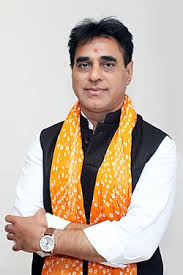
Gujarat State Health Minister- PRAFUL PANESARIYA
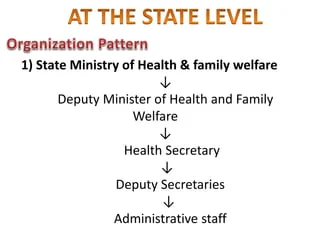
In India, all matters related to health have to be done by the state government. The administration pattern of all the states in India is similar to the central level, in which the work is done by the State Ministry of Health and the State Health Director
💚 State Minister of Health
The State Minister of Health in a state is the head of the Health and Family Welfare Department and is the deputy head of the Health Secretary and the Commissioner of Health and various directors working under it have their own political vision and accordingly the Health Secretary and a large number of administrative staff work accordingly.
💚 State Health Director (State Health Directorate)
This is a technical wing of the state level Health and Family Welfare Department in which the Director of Health and Family Welfare is its head, under which the work of Public Health and Health and Family Welfare Services as well as Family Planning Services etc. comes under it. There is also a Deputy Director to help him and in states like Gujarat there is also a Regional Deputy Director to do the main work of the old and for that Family Planning For services and health education
💚 Regional Deputy Director
Assistant R.D.D (regional deputy director) is a different department head who has to supervise and manage the operations of hospitals and other agencies in his area. There are a total of six RDDs in the state of Gujarat which are as follows,
1. Gandhinagar
2. Rajkot (Jamnagar, Kutch Bhuj and Rajkot)
3. Bhavnagar (Junagarh, Amreli and Bhavnagar)
4. Vadodara
5. Surat
6.Ahmedabad
💜 Functions of state health department ( Functions of State Health Department ):
Medical care– Works to provide adequate medical care and preventive care in rural and urban areas.
National health programme – Action has to be taken to implement the National Health Programme.
Communicable Disease control – Works for the control of Communicable Diseases, including planning, implementation and evaluation.
Promotion of health – Performs various activities for the promotion of health, including RCH (Reproductive and child health) Works for immunization program as well as school health program.
Food adultration– Maintaining the standard of food adultration and maintaining the standard of drugs.
Health and vital statistics – Collecting necessary information in accordance with health and vital statistics.
Reporting – Special report on some diseases that require adequate attention.
Health services– Provide health services everywhere, including in jails.
Facility– Provide facilities for education in medical, dental and nursing branches, pharmacy and sanitation branches etc.
Research- It gives importance to research and encourages it and provides related facilities.
Indigenous system of medicine (Swadeshi)– In which it encourages the development of branches like Homeopathy, Ayurvedic, Allopathic etc.
Storage of hospital drugs material and distribution It maintains a laboratory for the production and distribution of vaccines and toxoids which is located in Baroda.
Co-ordination – Maintains coordination for the development of health services and supervision of its workers through local organizations.
Sets and maintains standards of practice for different universities, councils, education branches, research centers and maintains health problems by identifying, studying diseases and taking necessary action to reduce morbidity and mortality. Prepares necessary acts for public health and medical care and provides health education.
Maintains regional investigation laboratories and tries to stay active.
💚Health organization at District Level (District Level Health Organization):-
Like the state level, the district level also has a CDHO (chief District Health Officer) in health services while the CDMO (chief District Medical Officer) is in charge of medical care. The CDHO is responsible for the supervision of all PHCs and block levels in the district and is also involved in the supervision of health related to the municipality. There is a Block Health in each district which is at the taluka level.
💜 Functions CDHO (chief District Health Officer )
- Preventive care
- Curative care
- Promotive care
They perform different functions in accordance with these three issues.
A. Direct supervision of PHC
B. Supervision of subcenter
C. Supervision and planning of whether the people of the community are getting adequate health services or not.
D. To see whether the national health program that runs up to the community level reaches the people or not.
E. Runs training programs.
F. Takes responsibility for posting, transfer or leave of health staff.
G. Family Welfare Services reach people
💚 Organization of block level ( Health Organization of Block Level):
👉There are 100 villages under a block, with a population of 80,000 to 1,20,000 (one lakh twenty thousand), which does all the work related to health. PHC and sub-centers are under it.
👉In the health organization at the block level, they organize health programs in the area associated with them, provide all the services, collect statistical information and provide it to the district, and provide health education to the people. Works as a link with the District Officer and infrastructure.
💚 Block level ( Block level ):
BDO (Block development officer)
⬇️
BEO (block extension officer)
⬇️
FHS (female health supervisor)
⬇️
BICO (Block information and communication officer)
⬇️
Clerk
⬇️
Peon
💚 Municipal Corporation ( Municipal Corporation ):
- It is formed when the population of a city exceeds two lakhs.
- It has a head mayor, who leads it.
- It has a council.
- Councilors are elected from different wards of the city.
- There are different committees of councilors in the corporation.
- His term of office is 5 years.
- At the administrative level, the executive agency has a CEO i.e. Chief Executive Officer Includes, which is also called commissioner, secretary, engineer and health officer.
✅️Functions (Functions) :
The functions of a municipal corporation are similar to those of a municipal board.
But it is on a larger scale. Which includes the following.
- health and sanitation of city
- Construction and maintenance of roads
- Safe drainage system
- street lighting
- Safe water supply
- maintenance of hospitals and dispensaries
- Education
- registration of birth and death
💚 Local level (local level)
💚 Municipality :
Municipality or municipality with a population of more than 10,000 and up to two lakhs. The municipality or corporation is responsible for providing services in urban areas.
💜 Function of Municipality :
1.Extra disposal and sanitation
2.Maternity services in which services are provided by FHW, which has a full-time or part-time medical officer.
3.Provides family planning services.
4.Control of stray dogs and disposal of dead animals.
5.Collect statistical information such as birth, death, marriage etc..
6.Immunization
7.Water supply
8.Control of food and food sanitation.
9.organization of city dispensary and indoor.
The municipal board has a head or president who is selected by the committee members of each board.
💚 Town :

👉Town is an area between city and village. It is neither a village nor a city.
👉Town area committee comes under the administration of district collector. Which is found in states like MP, UP, West Bengal, Kerala, Assam, Jammu and Kashmir, Himachal Pradesh etc.
👉They are like Panchayats. Town area committee covers a population of 5,000 to 10,000 and is responsible for maintaining sanitation in that area.
💚 Rural area/Rural Administration
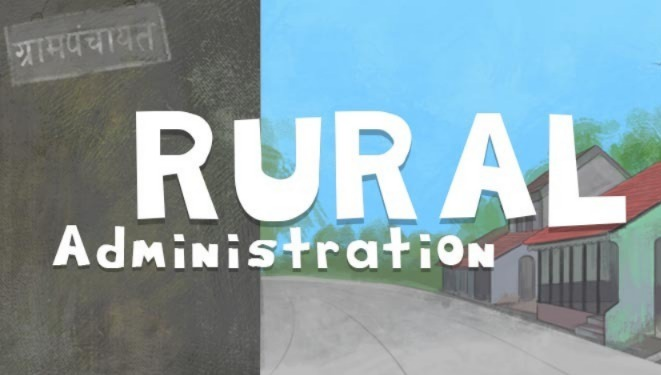
Village is the basic unit of rural life. The village administration is also run by the local Panchayat. It is divided into blocks. Health services are provided in the area as per the recommendations of the committee. PHC has different categories of staff and emphasis is laid on district hospitals to get additional facilities. Till 31/3/1987, there were 5532 CHCs in our country. On 30 June 1996, considering the population of PHC, 2424 were converted into PHC.
1.Village level
A. Gram Sabha (Gram Sabha) B. Gram Panchayat (Gram Panchayat)
C. Nyaya Panchayat
2.Community development block or Taluka Panchayat
3.District Level (District Council) or District Panchayat
💜 Village level
A. Gram Sabha (Gram Sabha)
A Panchayat is a unit of the state system in which all the adult people of the village meet. The meeting is held twice a year and is called Gram Sabha. The Gram Sabha is also held when the superior officer orders for special work.
B. Gram Panchayat
The Gram Sabha is the executive organ of the Gram Sabha and has 15 to 30 members. The members of the Gram Sabha are selected by the adults of the Panchayat. The head of the Gram Panchayat is called Sarpanch or Mukhi. The term of the members of the Gram Panchayat is five years, the day in which the election of the Upsarpanch is held in the year is considered the first day of the members.
Function of gram panchayat :
- Sanitation
- Streat light
- Control of disease
- Adult literacy
- Youth club
- Statistical birth and death registration The secretary of the Panchayat helps the Panchayat in various activities.
C. Nyaya Panchayat (Nyaya Panchayat)
It is the judicial organ of the Gram Sabha. It tries to dispose of civil cases and minor criminal cases. And when necessary, they also impose a fine of up to one hundred rupees
💜 Taluka Panchayat ( community block )
A block consists of 100 villages or a population of 80,000 to 1, 20,000. It is administered by a Panchayat Committee, which consists of the Sarpanchs of 100 villages. Apart from this, there are MLA Members of (legislative assembly) in the block who take part in the block area.
In addition to the representative of MLA Schedule cast, schedule trip, there is a (block development officer) in the block, who is the (official secretary) of the Panchayat Committee.
👉Function
- The District Council acts as a supervisory and co-ordination body. The functions of this committee vary from state to state.
- In Gujarat, many financial functions of PHC and Council are done by D.H.O.
- Education
- Construction
Community development programme
Since 2 October 1952, community development in India The programme was started as part of the National 5 year plan and this scheme became very popular.
✅️Objective
-
- The main objective of this scheme is to improve and help the lives of 80,000 people in rural areas.
-
- To reduce poverty, ignorance and disease of the people.
👉Function
-
- Planning and implementation of the health program is responsible to the authority.
-
- Development of agriculture
-
- Improvement of communication
-
- Education
-
- Improvement of health
-
- Rural sanitation
-
- Improvement of housing arts, crafts, cottage, industries
-
- Animal husbandry (relating to animal farming)
-
- Co-operative marketing
-
- Special program for women and children and baalvadi
Administration or setting pattern of community health :
-
- BDO( Block development officer )
-
- Extension officer who is trained by the government Handles the work of the block.
-
- Social education organizer (S.E.O) Male and female
-
- Village level worker – 10
-
- Public health worker- 1
-
- Mukhya Sevika – 1
👉How many women are also involved in this, who work with the village leader and solve the problems of the people with the help of the extensor officer Meetings are organized to know and fulfill the needs. Every PHC is also involved in this. Three servants work under the block.
👉 People’s health as well as agricultural, industrial or education etc. are also included in this work. This community development programme is for the people, by the people, for the people. Under this project, 300 villages, an area of 150 to 200 miles and a population of about 60 to 10,000 are covered.
👉At present, there are more than 50,000 blocks in our country. Our late Pandit Jawaharlal Nehru used to say, “These centers of human activities are like a lamp that spreads light in the surrounding darkness.”
💚 Structure of Nursing services at central level ( Structure of Nursing Services at Central Level ):
Nursing at Central Level The advisor is a responsible person of the government.
Function of central level nursing services:
👉1. Prepares policy for nursing.
👉2. Discusses and plans issues related to nursing and sends it to the government.
👉3. Maintains the standard of nursing services and prepares policy for hours of nursing duty.
👉4. Prepares job description.
👉5. Evaluates nursing services.
👉6. Upgrades nursing education by organizing short term courses. Organizes refresher courses and plans how to utilize the assistance provided by WHO and UNICEF.
Organization at state level:
At the state level, the Assistant Director of Nursing is responsible for the nursing profession in the entire state.
Function ( Function ):
- Sets policies to ensure that the standard of nursing services is maintained.
- Supervises.
- Performs necessary work for posting and transfer of nursing staff.
- Resolves health problems.
Nursing services at district level:
Very few states have the post of District Nursing Supervisor.
Function ( Function ):
- District Health Services DPHNO supervises the health workers and health assistants of PHCs and sub-centres Provides necessary guidance.
- Evaluates.
- Organizes refresher courses for workers.
- Organizes seminars and camps for workers when necessary so that their knowledge can be upgraded.
FOR UNLOCK 🔓 FULL COURSE NOW. MORE DETAILS CALL US OR WATSAPP ON- 8485976407
To unlock the full course 🔓 or for more information, contact or whatsapp the following number.-
8485976407