ENGLISH-unit-12-neurological Disorder(part-2)(UPLOAD)
Explain/Define Altered level of consciousness.
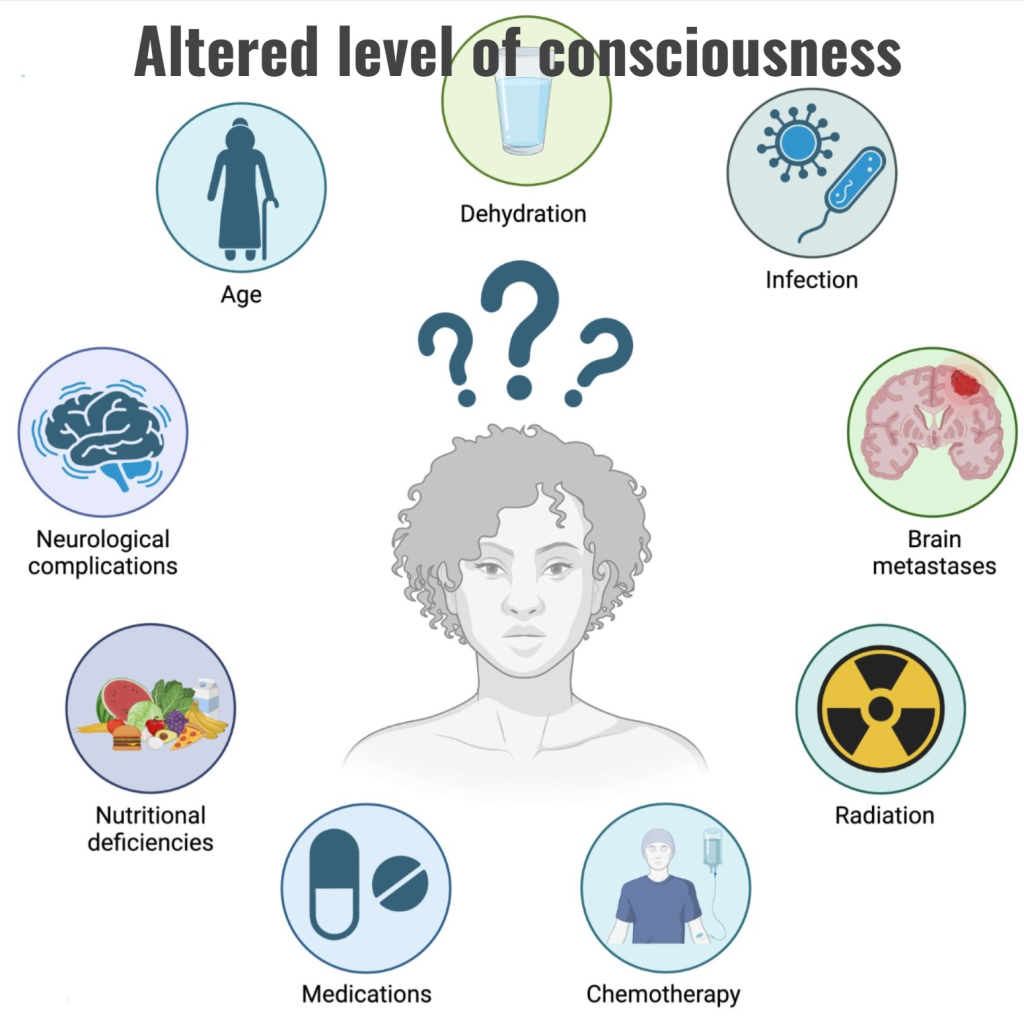
- The level of consciousness means that any person is aware of himself and his surrounding environment, it is called the consciousness of the person.
- In an altered level of consciousness, the arousal of the person is seen to be different from that of a normal person.
- That is, the arousal of the person is seen to be altered in response to stimuli from the external environment.
- An altered level of consciousness means when any person is aware of himself and his surrounding. A person who is unaware of their environment (time, place, person) is said to have altered consciousness.
Altered levels of consciousness are classified as follows.
- 1) Conciousness,
- 2) Confusion,
- 3) Lethargy,
- 4) Obtunded,
- 5) Stuper,
- 6) Coma.
1) consciousness,
- In the state of consciousness, a person is aware of himself and his surrounding environment and of time, place and person.
2) Confusion,
- In the state of confusion, a person is aware of time, place and person. Not oriented and cannot think rapidly and has a short attention span.
3) Lethargy,
- In the lethargy state, the person experiences a slight depression along with loss of consciousness, but in this stage the person is oriented to time, place and person.
4) Obtunded,
- In this stage, the person feels very drowsy and can follow simple commands when stimulants are provided. This is accompanied by a moderate decrease in the level of consciousness. The response is very slow.
5) Stuper,
- In this stage, the person is not properly aroused but follows the command only when a painful stimulus is provided. In this condition, there is a severe decrease in his level of consciousness.
6) Coma (Coma).
- In the coma stage, the person is unable to provide an appropriate response to environmental stimuli. In this stage, an unarousable condition is present.
Explain the Etiology/ cause of the Altered level of consciousness.
- Due to traumatic brain injury.
- Due to infection.
- Due to metabolic disorder.
- Due to Intoxication
- Seizure.
- Stroke.
- Hypoxia.
- Neurological disorders such as epilepsy,
- Multiple Sclerosis, Certain tumors.
- Psychiatric conditions.
- Due to alcohol and substance abuse.
- Due to low blood sugar.
Explain the Clinical manifestation/ sign and symptoms of the patient with the Altered level of consciousness. (Describe the symptoms and signs of an altered level of consciousness patient.)
- Responsiveness decreases.
- Confusion.
- Disoriented.
- Memory is impaired.
- Abnormal motor response to occur.
- Changes in speech.
- Changes in pupillary response.
- Abnormalities in vital signs.
- Seizures.
- Abnormal posture.
- Loss of bowel and bladder control To be done.
Explain the Diagnostic evaluation of the patient with the Altered level of consciousness. (Explain the diagnostic evaluation of the patient with altered level of consciousness.)
- History taking and physical examination.
- CT scan.
- M .R .I.
- Cerebral Angiography.
- Doppler Study.
- Serum Electrolyte Assessment.
- ABG IS DONE.
- Toxicology Screening.
- CSF Analysis.
- Blood test.
- Neurological assessment.
- Laboratory studies.
- Electroencephalogram (EEG).
- Toxicology screening.
Explain the medical management of the patient with the Altered level of consciousness. (Explain the medical management of the patient with the Altered level of consciousness.)
- Provide supportive care to the patient.
- Assess whether the patient’s airway, breathing, and circulation are proper.
- Properly monitor the patient’s vital signs.
- Properly perform a neurological assessment of the patient.
- Identify and treat the cause of the patient’s illness Treat early.
- If the patient has any infection, provide him with proper antibiotic medication.
- If the patient has a seizure condition, provide the patient with antiepileptic drugs.
- If the patient has a fever condition, give antipyretic medicine.
- Maintain the patient’s fluid and electrolyte balance.
- Provide proper fluids to the patient.
- Provide proper nutritional support to the patient.
- Advise the patient to take proper measures to prevent complications.
- Provide proper rehabilitation therapy to the patient.
- Provide proper physical therapy, occupational therapy, speech therapy to the patient. To do.
- Provide proper psychological support to the patient.
- Advise the patient to follow up properly.
Explain the Nursing management of patients with the Altered level of consciousness. (Explain the nursing management of a patient with an altered level of consciousness.)
- Properly assess the patient.
- Properly assess the patient’s level of consciousness.
- Keep the patient’s airway properly patent.
- Properly provide oxygen to the patient.
- If the patient is intubated, suction him properly.
- Change the patient’s position properly every 2 hours.
- Provide postural drainage to the patient.
- Assess the patient for gag reflex.
- Properly assess the patient’s neurological status.
- Provide the patient with proper side lying position.
- Provide the patient with proper side lying position and change position frequently to prevent pressure ulcers.
- Properly assess all pressure points of the patient.
- Provide the patient with proper comfort devices.
- Advise the patient to do range of motion exercises Provide.
- Properly maintain the nutritional status of the patient.
- Provide the patient with a high-calorie and high-protein diet.
- Advise the patient to take medication properly.
- Provide complete information about the patient’s disease, its symptoms and signs, causes of its occurrence, and its treatment to the patient’s family members.
- Maintain proper safety of the patient.
- Properly collaborate with other health care personnel for the treatment of the patient.
- Provide proper psychological support to the patient and his/her family members.