ENGLISH-fluid and electrolyte-part-2-UPLOAD
Homeostasis:
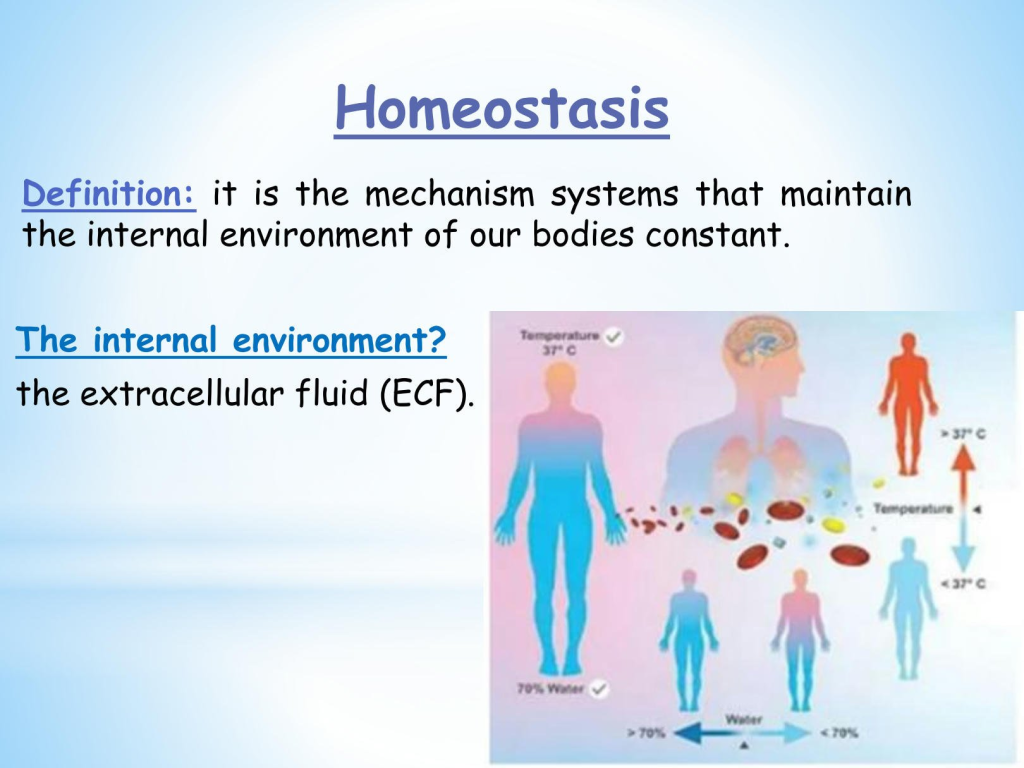
Write (short notes) Regulation of fluid balance or Homeostasis of fluid (Regulation of fluid balance or Homeostasis of fluid):
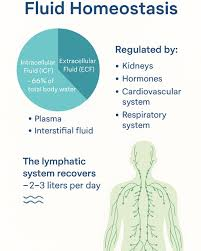
- Fluid balance in a normal body is normal.
- Balance means that the intracellular, extracellular and plasma and total water volume of the body are constant.
- In normal conditions, the total water volume of the body is responsible for normalizing homeostasis of the body.
- Regulation of body fluids occurs in the hypothalamus (osmoreceptor)
- The hypothalamus receives fluid from the digestive tract.
- Regulation of body fluid is done by ( ADH : Anti diuretic hormone).
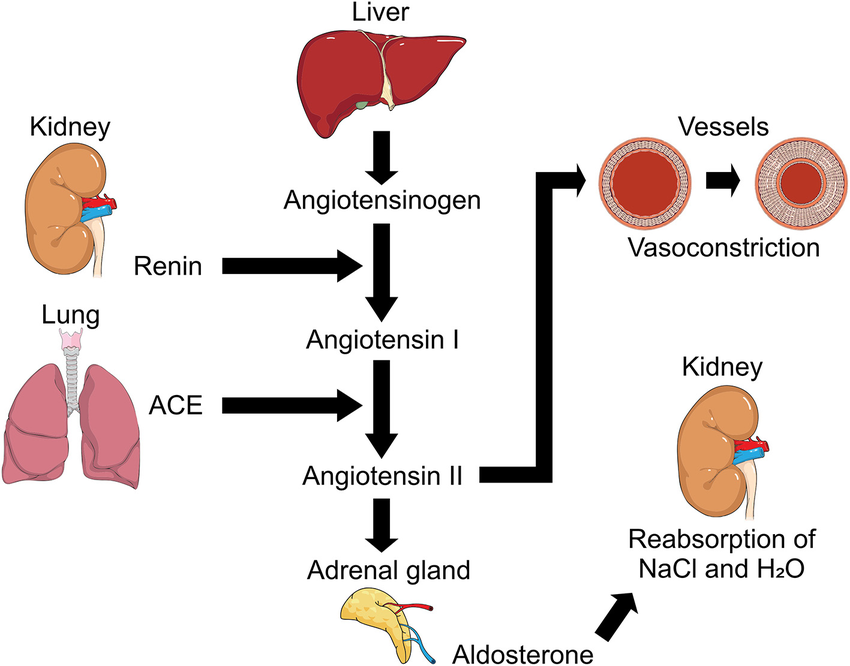
- When the fluid volume or blood volume in the human body is reduced, the RAAS (renin angiotensin aldosterone system) is activated to activate it.
- When the blood volume or body fluid volume is reduced, the juxtaglomerular cells Which is located in the Bowman’s capsule of the kidney, it secretes the renin hormone.
- Now when the liver secretes the angiotensin hormone.
- Then the renin hormone converts angiotensinogen into angiotensin-1.
- Angiotensin-converting enzyme (ACE) is secreted from the lungs, which converts angiotensin-1 into angiotensin-2.
- Angiotensin 2 acts as a vasoconstrictor.
- Due to this, the blood vessels contract and the amount of blood increases and the amount of fluid also increases.
- And angiotensin-2 activates the adrenal gland and releases the aldosterone hormone from it.
- This hormone causes sodium reabsorption, which causes water retention.
- Due to this, the blood volume also increases and blood pressure also increases.
- Now on the other hand, when the fluid volume in the body decreases.
- Then ADH (Anti Diuretic Hormone) is released from the posterior pituitary gland of the body.
- When the diuretic hormone excretes the fluid retained in the body.
- When the anti diuretic hormone is released when there is a condition of dehydration in the body is.
- Due to this, the fluid remains in the body and the condition of dehydration in the body can be prevented.
- Thus, ADH i.e. antidiuretic hormone and diuretic hormone both play an important role in keeping the body’s fluid balance normal.
(Review mechanism of regulating fluid and electrolyte movement)
Explain the movement of body fluid/fluid exchange processes:
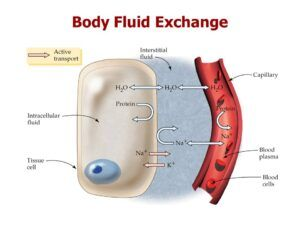
- Fluids, electrolytes, gases, and small molecules can move freely across a semipermeable membrane, and this semipermeable membrane separates the two compartments in which oxygen and nutrients are carried by the cell. Waste products are removed from the cell and this process can be done by both active transport and passive transport.
- An example of active transport is the sodium potassium pump.
- In active transport, the substance remains on the surface of the cell and is transported into the cell.
♠ Example of passive transport:
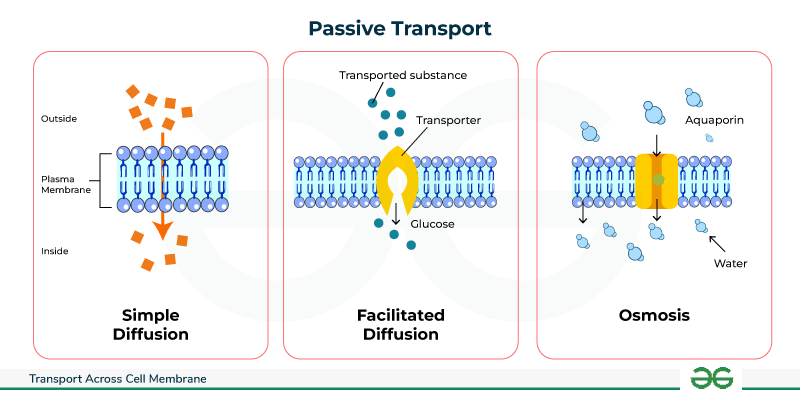
1.Diffusion
2.Osmosis
3.Ultrafiltration includes.
♠ Active transport (Active transport):
♠ Sodium potassium pump:
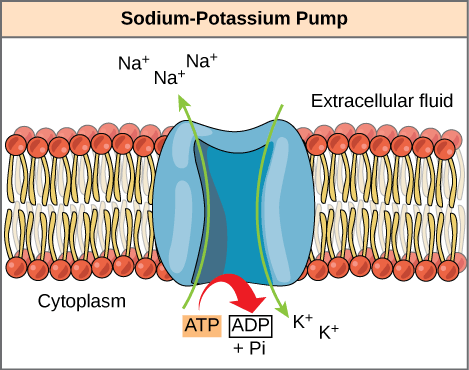
- The sodium potassium pump is located in the cell membrane.
- It contains ions.
- In this, sodium ions are continuously allowed to remain outside the cell and potassium ions are allowed to remain inside the cell and this is mainly done by ATP (adenosine triphosphate).
- Each ATP is broken down and three sodium ions ( Keeps 3 Na+ ions outside the cell and helps keep two potassium (2 k+) ions inside the cell.
- And due to this, sodium is depleted inside the cell and due to this, electrical gradient and concentration gradient are created. And fluid balance is maintained.
♠ Example of passive transport :
1) Diffusion :
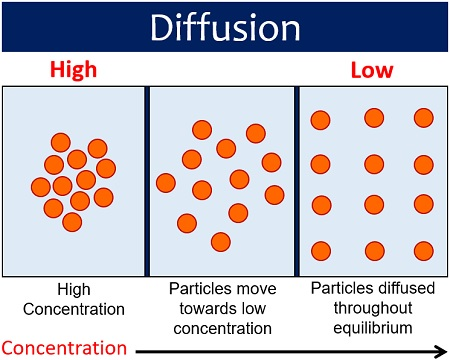
- Diffusion is a process in which (atoms, ions, molecules) are transported from a higher concentration to a lower concentration and this process occurs along a concentration gradient.
- In diffusion, molecules are transported from a higher concentration to a lower concentration in a semipermeable membrane.
2) Osmosis :
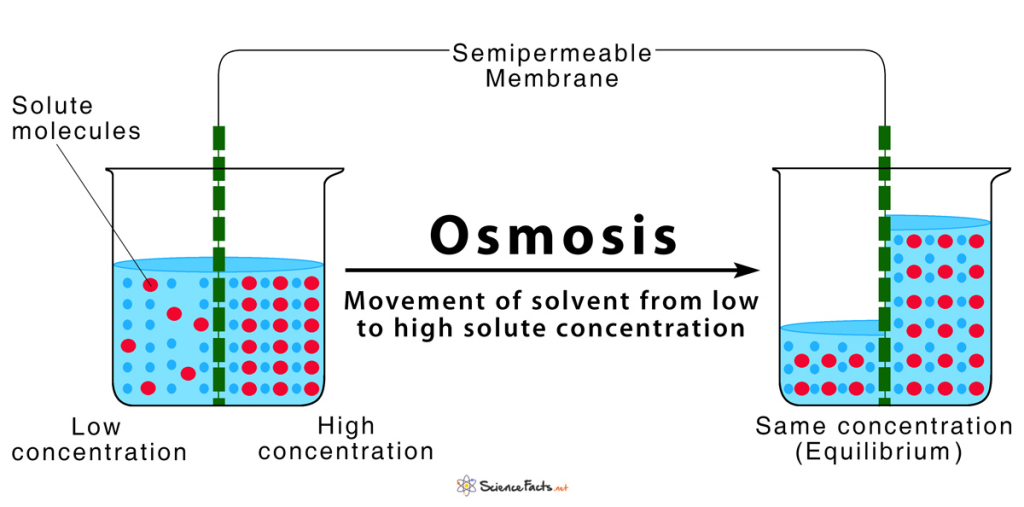
- Osmosis is the process in which water molecules pass through a semipermeable membrane with a low solute concentration. From an area with low solute concentration to an area with high solute concentration, until the solute concentration on both sides becomes equal. This process occurs without energy, meaning it is a passive process. Osmosis plays a very important role in maintaining fluid balance in the body and cell hydration.
3) Filteration :
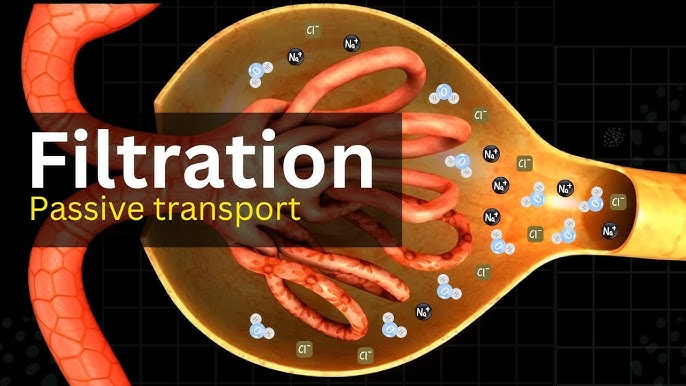
- Filtration is a process in which water and other diffusible particles can move through a membrane. This is mainly due to the fact that one side of a semipermeable membrane has a higher concentration and the other side has a lower concentration.
OR
- Filtration is a passive process in which water and small solute molecules are forced through a semipermeable membrane by hydrostatic pressure. (hydrostatic pressure). In other words, Filtration is a process in which the liquid and small particles in a solution move from an area of high pressure to an area of low pressure. This process occurs in the body, especially in the kidneys, where wastes are filtered from the blood through glomerular filtration.
♠ composition of body fluid:
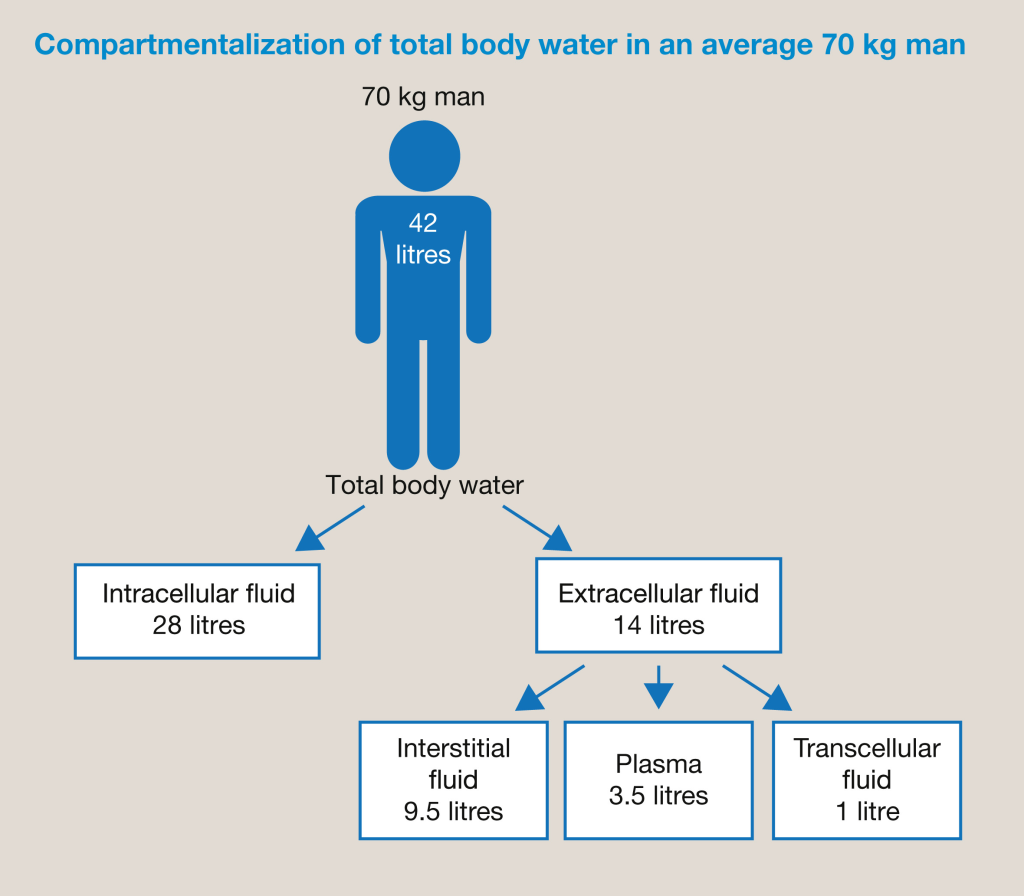
1) Water works as the main component in all body components.
2) Water is about 45% – 75%.
3) sources of water include:
ingested foods and liquid metabolic water.
4) Solutes are broadly classified into:
Electrolyte are inorganic salts, all acid, bases and some protein.
Nonelectrolyte : example glucose, lipids, creatinine, and urea.
electrolyte have greater osmotic power than nonelectrolyte.
♠ Electrolyte composition of body fluid :
1) Extracellular fluid:
Sodium (Na+) is major cation.
2) Intracellular fluid:
Potassium ( k+)is the chief cation.
Phosphate (po4-)is the chief anion.