ENGLISH-ENT-part-2
b) Assessment of function of ear
- History
- Ear examination
- Diagnostic tests
♣ History :-
1.Demographic Data :- Including information related to his/her residence/residence
2.Personal History :-
- Ask the patient about his/her history and whether he/she has any kind of hearing problem.
- Is there a sound like tinnitus in the ears?
- If there is any kind of pain in the ears, drainage, loss of balance, dizziness (Giddiness and Dizzines), difficulty in hearing, then a history should be taken.
- The method of cleaning the ear and whether the person is a swimmer or not should be taken.
3.past health history:-
- Ask the patient if there is any type of infection such as
- Meningitis,
- acute otitis media,
- Upper respiratory tract infection,
- acute or chronic sinus infection Infection),
- Ask the patient’s history about whether he has had any such infections.
- Ask whether the patient has taken M.M.R or hib( Haemophillus Influenza-B) vaccination.
- Ask whether the patient is taking any kind of medicine or not Ask whether the patient is taking any kind of medicine or not because this medicine damages the vestibulocochlear nerve. Such as
- aspirin , salicylate (these are ototoxic drugs that cause hearing loss and tinnitus)
- chemotherapy drugs-cisplatin (Platinol) and carboplatin (Paraplatin) and taxanes such as paclitaxel (Taxol) and docetaxel (Taxotere). Tinnitus is often the first sign of damage caused by chemotherapy.
- quinine group drugs
- Streptomycin- Vestibular damage due to streptomycin is common with prolonged use and in patients with impaired renal function
4.family 👪 history : (family history)
- Ask any family members of the patient if they have hearing loss or ear problems.
5. psychosocial history: Psycho-social history
- Ask the patient about his/her occupation. Ask if there are any places with high noise levels in the occupation. Ask the patient if he has a habit of putting any kind of earbuds, pins, pencils in his ears. Especially people working in industries. Also people living in noisy places like railways, airports and big industries.
♣ Ear Examination :-(Ear Examination)
- Usually the ear canal is the same color as our skin. And there are a few hairs in it
- Inspect the shape, size, and color of the ear during an ear examination
- There is a yellowish brown ear wax in the ear called cerumen, which is commonly seen.
- The eardrum is a light gray or shiny white color
- inspect the auricle for any redness, scales, or skin lesions.
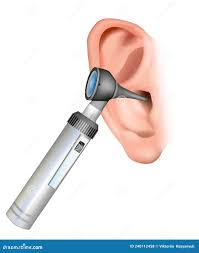
- inspect the external auditory canal with an otoscope for any discharge, redness, impacted cerumen, Look for purulent drainage, foreign body.
- Palpate the auricle and lower mastoid processes to see if there is any pain or swelling.
- Hearing problem, Pain, Discharge, Lump, Any foreign material. To see if there is any other problem of the outer.Middle or Inner Ear.
♣ Ear Diagnostic tests or List the Ear Diagnostic Test or Write Short notes on Ear Diagnostic test :-
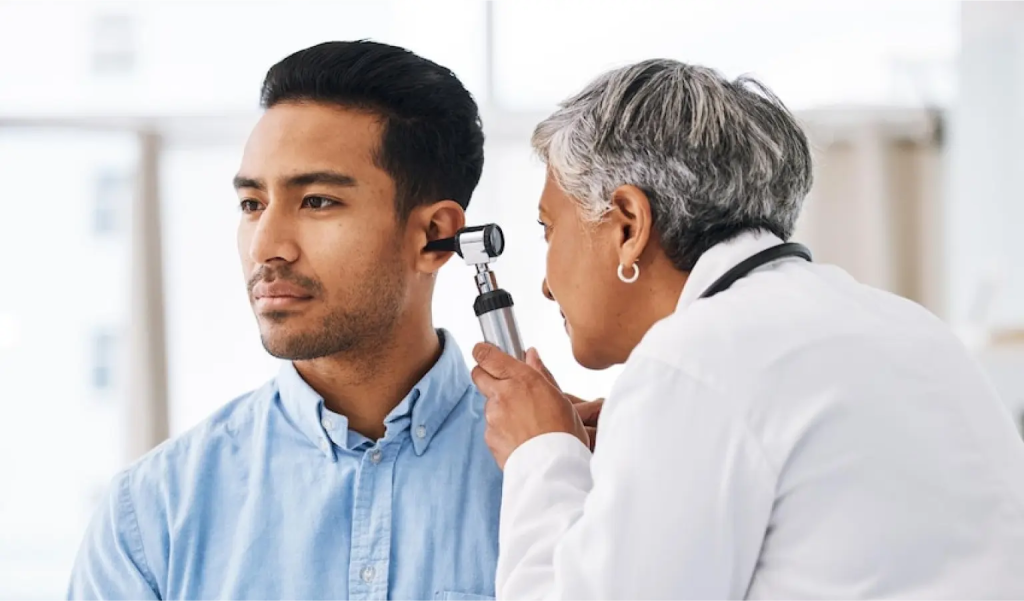
♦ otoscopic examination (otoscopic examination)
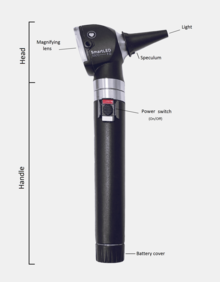
- Otoscopy examination An ear examination is performed using an otoscope.
- Otoscopic examination is part of a normal physical examination.
- It is called.
- In this, the patient is asked to sit and his head is slightly tilted to the side of the shoulder so that the ear can be examined properly.
- Which can determine whether there is any infection, redness or foreign object in the ear and ear wax build up etc.
- Any physician or nurse can do this. An otoscopic examination is performed as part of a complete physical examination.
- The tympanic membrane is examined for any signs of rupture or puncture and for hearing loss.
- An examination of the ear is performed if there is any suspected infection, the patient complains of pain, or hearing loss.
♦ whispered speech test (slurred speech test)
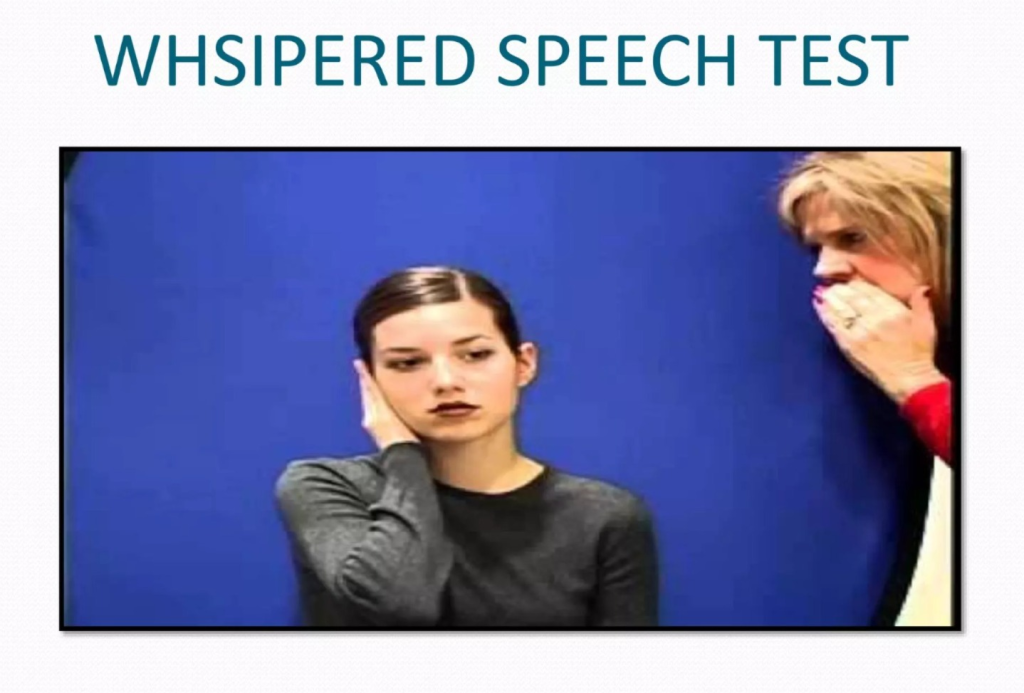
- In this whispered speech test, a health professional asks the patient to cover one of his ears with the fingers of one hand. The health professional stands a foot or two behind him. He says a series of words. He has to repeat these words. If he does not hear them, the health professional says these words out loud. The health professional says the series of words until he can hear them. Hearing in one ear and the other ear. Checked separately.
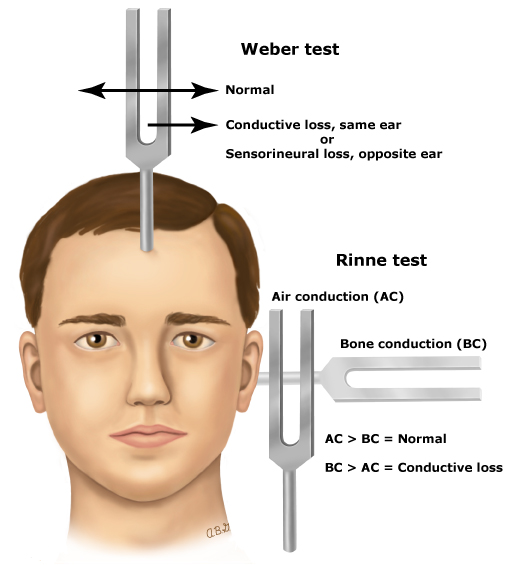
♦ weber and rinne test
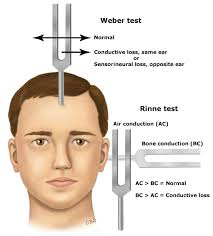
◘ Bone conduction hearing test : =
Rinne Test
- In this test, a vibrating tuning fork is placed behind the ear on the mastoid process It is placed on the mastoid process. If the patient does not feel the vibration for a long time, then the tuning fork is placed in front of the ear. If the patient is not able to hear the ringing sound, then the patient can be said to have conductive hearing loss in that ear.
Weber Test-Weber
In addition, the tuning fork is placed on the forehead. Then the patient is asked whether the sound is heard in the middle of the forehead. Does it happen or not. Or is the sound louder in both ears?
- If the patient has conductive hearing loss, the affected ear will hear more sound.
- If the patient has sensorineural hearing loss, the sound will be less in that ear.
- This test is done to help the audiologist determine what type of loss is present.
- In conductive hearing loss (caused by a problem in the outer or middle ear),
- In sensorineural hearing loss (caused by problem in the cochlea, the sensory organ of hearing)
- Or neural (caused by a problem in the auditory nerve or auditory pathway of the brain).
♦ Pure tone audiometry:-
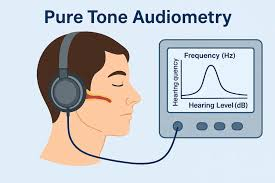
- Pure tone audiometry is a test of hearing ability.
- Pure tone audiometry uses machines called audio meters to play a series of tones through headphones.
- The tone changes in pitch (frequency: measured in hertz and intensity measured in decibels).
- The health professional will control the volume of the tone and reduce its volume until the patient can hear it.
- Then the tone will increase in volume until the patient can hear it again. Whenever he or she hears a sound You can signal by raising your hand or pressing a button when you hear it, even if the sound you hear is very faint.
- The health professional will then repeat this test several times, each time using a different method. Then the headphones will be removed and a special vibrating device will be placed on the bone behind the patient’s ear. Again, the patient will respond when you hear the tone.
♦Tympanogram/Tympenometry (Tympanogram)
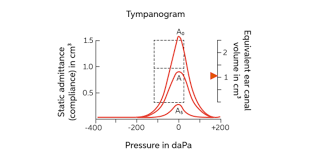
- In this test, a small probe is placed inside the ear. And air pressure is applied. This test is performed by an audiologist to check the working condition of the eardrum and the structures of the middle ear. Ear canal volume is a measure of the perforation of the ear drum Middle ear pressure indicates whether there is fluid in the middle ear space. This measurement is done to see if the ear drum and the three middle ear bones are working properly.
♦ Auditory brainstem response testing (ABR)( Auditory Brain Stem Response Testing).
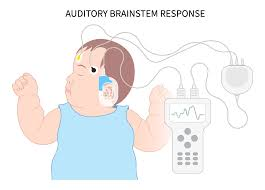
- ABR testing detect sensorineural hearing loss (sensory neural hearing loss). In the test, electrodes are placed on the head and on the earlobes. Then clicking sounds are sent through the ear phone. These electrodes monitor the brain’s response to the clicking sounds and record their response on a graph. This test is called (BAER:=BRAINSTEM AUDITORY EVOKED RESPONSE) AND( ABEP := AUDITORY BRAINSTEM EVOKED POTENTIAL ).
♦Electronystagmography:
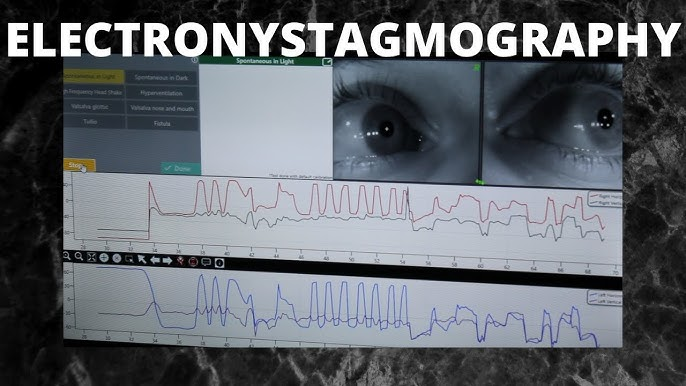
An electronystagmography (ENG) test measures your eye movements and the health of your cranial nerves. It involves placing small metal discs (electrodes) around your eyes, which measure nerve function. ENG test to check for balance disorders or other inner ear problems.
- Electron. Astigmography is the measurement and graphic record of changes in electrical potential caused by spontaneous, positional, eye movements.
- It is a study used in the medical evaluation of patients with dizziness or imbalance.
- This test is used to determine the function of the vestibular system, which controls the retina. Monitors head position and movement to stabilize.
- This information is integrated with visual and spinal connections in the brainstem to produce the vestibulocochlear reflex.
♦ caloric test
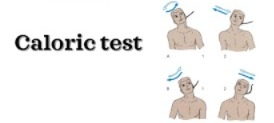
- This test, used to assess the function of the vestibular system, involves placing cold or warm water in the ear canal. The canals are irrigated and the client is observed for nystagmus (i.e., repeated abnormal movements of the eyeballs). When nystagmus occurs in the opposite direction to the irrigation, it is a normal response. If nystagmus does not occur, it indicates brain stem damage and further evaluation is required.
♦ Middle ear endoscopy
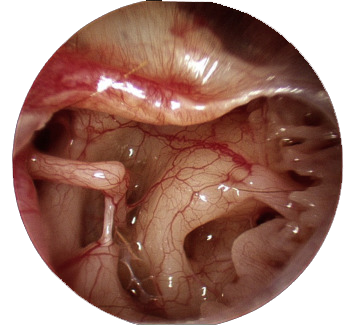
- In this, the middle ear is examined using an endoscope to see if there is any acute or chronic middle ear infection or to see if there is any abnormality.