ENGLISH-INTEGUMENTARY PART-3(UPLOADED)
Write Common nursing diagnosis and care for skin disease
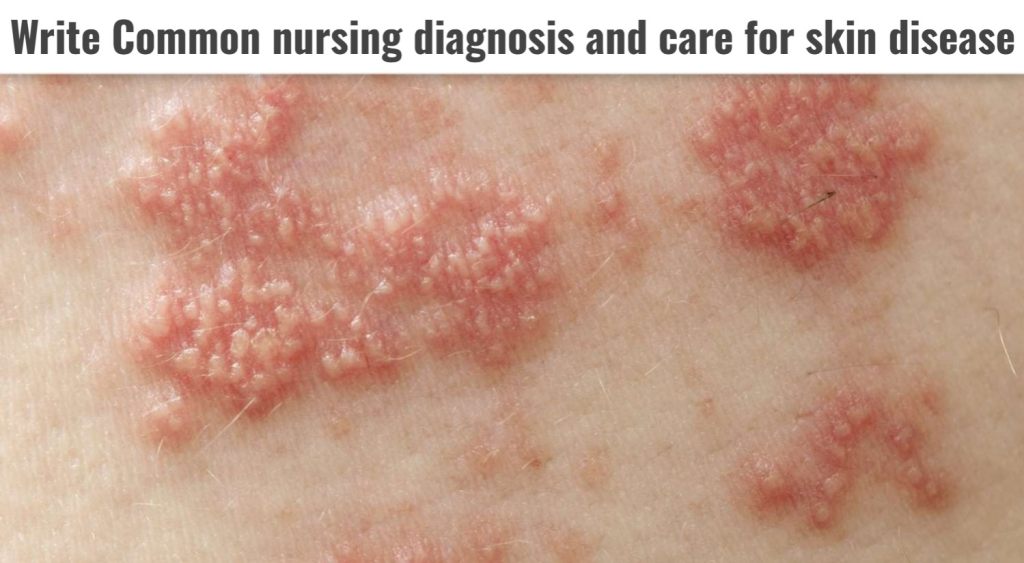
Impaired skin integrity related to ruptured blister area on skin
Maintain skin integrity
- (Maintain skin integrity)
- • Assess skin color, temperature, texture, moisture, mobility, edema, and hydration level.
- • Skin lesions To assess.
- • Apply topical medicine to the wound or lesion on the skin.
- • Apply regular dressings to the wound on the skin. So that healing is easy and infection can be prevented.
- • Provide warm moist compression.
- • Encourage the patient to maintain daily skin care.
- • Ask the patient to use warm water while bathing and dry the skin thoroughly after bathing.
- • Avoid rubbing and friction while drying the skin.
- • Then apply topical medicine to the wound or lesion.
- • Apply petroleum jelly to the skin to prevent drying out.
- • Change position every two hours to prevent bed sores.
Acute pain related to tissue damage or break in tissue integrity
Relieve Pain
- (Relieve Pain)
- • Assess pain level.
- • Assess location, duration, and intensity of pain.
- • Assess factors that trigger pain.
- • The patient Provide a comfortable position.
- • Provide warm moist compression to the patient.
- • Provide mind diversional therapy to the patient. So that the patient’s attention is diverted from the pain.
- • Advise the patient about relaxation therapy.
- • Administer prescribed analgesic medicine.
Risk for infection related to loss of protective barrier of skin and mucous membrane
Prevent Infection
- (To prevent infection)
- • Assess skin integrity.
- • Assess whether signs of infection are present. If redness, swelling, fever is observed, note it.
- • Always keep the wound covered and dress it regularly.
- • Use aseptic technique while dressing.
- • Tell the patient not to touch the wound site.
- • Provide strict isolation to the patient.
- • To meet the patient’s relatives Say no.
- • Educate the patient about hand washing and personal hygiene techniques.
- • Administer antibiotics prescribed by the doctor to prevent infection.
Risk for hyperthermia related to inflammatory process
Prevent hyperthermia
- (Preventing hyperthermia)
- • Assess the patient’s vital signs.
- • Maintain the patient’s room temperature.
- • Provide cold applications to the patient.
- • Avoid cold applications if the patient feels cold and provide the patient with a blanket Do.
- • Administer antipyretic drugs if body temperature is high.
- • Monitor temperature frequently.
Disturbed body image related to appearance of skin
Increase self-esteem and body image
- (Increasing self-esteem and regulating body image)
- • Know the patient’s attitude towards his physical appearance.
- • Encourage the patient to express his feelings and emotions.
- • Spend enough time listening to the patient.
- • Help the patient increase his self-esteem and his coping power Increase.
- • Comfort the patient.
- • Provide psychological support to the patient.
- • Give the patient ideas to enhance their body appearance.
- • Provide the patient with knowledge about cosmetics and accessories so that the scar does not draw too much attention.
- • Explain the patient about the skin condition and its treatment modalities To do.
- • Provide knowledge about cosmetic surgery to the patient.
Anxiety related to physical appearance of skin and prognosis
Reduce anxiety
- (Removing Anxiety)
- • Assess the patient’s condition.
- • Pay attention to the patient’s psychological needs and listen to the patient carefully.
- • Encourage the patient to express his feelings, discomfort and anxiety.
- • Answer all the patient’s doubts and queries To solve.
- • Provide the patient with knowledge about his condition and treatment so that his anxiety is removed and the patient becomes confident.
- • Provide psychological support to the patient.
- • Provide the patient with mind diversionary therapy and recreational therapy.

Published
Categorized as Uncategorised