ENGLISH-FIRST YEAR BEHAVIOURAL SCIENCES 09/09/2025 PAPER SOLUTION (COMPLETE)
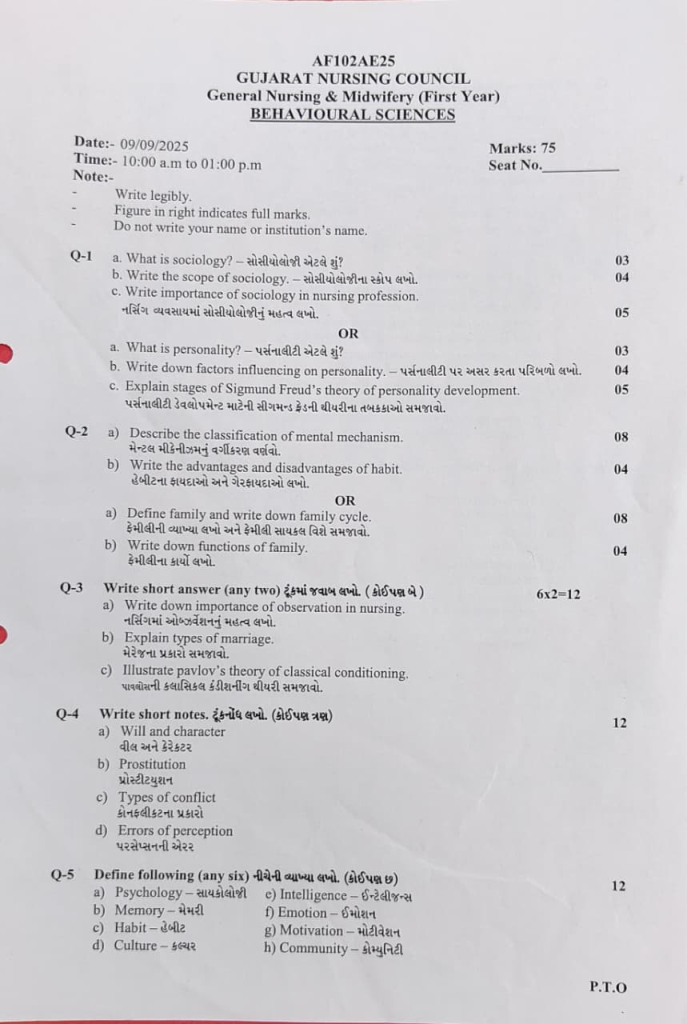
Q-1
a. What is sociology? – What is sociology? 03
- Sociology is a word made up of two words: Societus, which is a Latin word. It means society. The word logy is derived from the Greek word logos, which means to study or to study.
- Sociology means the scientific study of the society, that is, the scientific study of the people living in the society is called sociology.
- The basic component of society is the culture and its structure among the people of the society.
- Sociology studies the behavior of any person among the people living in the society.
b. Write the scope of sociology. – Write the scope of sociology. 04
- Sociology is a very fast-growing subject. Which is developing very rapidly for the study of different phases of human social life in society.
- The following sub-divisions are developing in sociology.
Social Morphology.
- In this, the geographical study of life is done and the problems of population are also studied.
Social Physiology
- This is a branch of sociology that deals with social facts. In which religion, morals, ethics, language etc. are studied from the aspect of sociology.
General Sociology.
- In which the general characteristics of the relationship between society and the people living in it are studied.
Rural Sociology.
- In which sociology related to rural areas is studied.
Industrial Sociology.
- Sociology related to industry and people working in industry and living there is studied.
Urban Sociology.
- It includes the scientific study of individuals living in urban areas and their society.
Educational Sociology.
- It involves the scientific study of matters related to education among the people of the society.
Occupational Sociology.
- In this, sociology is studied related to the people living in the society and their different occupations.
Cultural Sociology.
- In this, scientific studies are done related to different people living in the society and their different cultures.
Political Sociology.
- In this, scientific studies related to different political groups and political activities are conducted.
- In addition, in sociology, scientific studies of medical sociology, military sociology, sociology of family and various other branches of sociology are conducted.
c. Write importance of sociology in nursing profession. Write importance of sociology in nursing profession. 05
- It is a very important branch for the scientific study of society and the people living in society.
- The study of sociology is very important in the nursing profession for many issues related to patients, patient treatment, and the hospital and health care team.
- Sociology is very important for hospital staff in understanding the culture and social life of patients.
- Through the study of sociology, one can learn about the diversity of different religions of different people and their castes and communities.
- During the treatment of a patient, the customs, beliefs, etc. related to him can be kept in mind during the treatment and treatment can be provided.
- Through the study of sociology, cooperation and team spirit are maintained among individuals. While working with patients in the hospital as a nurse, team spirit and cooperation can be achieved through the study of sociology.
- Through the study of sociology, social relationships can be maintained well during the treatment of the patient, his recovery, and also in the different types of nursing care provided to him, and the patient’s confidence can be won.
- While working in the community, through the study of sociology, information about the community, and the culture and knowledge of the people living there is obtained, and along with it, sociology is very important in preventive services.
- Different branches of sociology Through the development of the branch, sociology has also become very important in different aspects of nursing like industrial nursing, public health nursing.
- Through the study of sociology, social problems arising during treatment can be understood and resolved so that good treatment can be given to the patient.
- Thus, through the study of sociology, high quality patient care can be provided and patient participation can also be achieved.
OR
a. What is personality? – What is personality? 03
- A person uses the word personality in different ways in his life. Some people limit the use of the word personality only to physical appearance, structure and color. But personality contains the overall characteristics of a person. In which a person is good or bad, strong or weak, all these things are covered. We use the word personality in our life to a large extent.
- The word personality means persona which means like a mask. During the Greek drama, the actors there used this.
- After that, this word has also been used by different psychologists. Personality shows the overall quality of a person. Which covers a person’s habits, thinking, attitude, interest and his philosophy of life etc. Every aspect of this personality can be seen through the behavior of a person which completely distinguishes one person from another and creates his personal identity.
- Personality shows the total ability, characteristics and his behavior of a person. Which a person has naturally or has been artificially developed by him. Which distinguishes him to some extent or more from other individuals.
b. Write down factors influencing on personality. – Write down factors influencing on personality.04
Factors influencing the development of personality:
Personality is the set of unique characteristics, thoughts and behaviors within a person, which shape his identity and progress in life. Various factors affect the development of personality, which are basically the influence of a person’s life circumstances, hereditary qualities and the environment.
Main factors affecting the development of personality:
- Hereditary factors:
The genetic material obtained from a person’s lineage has an important influence. Inherited physical traits, mental abilities, and some health conditions shape a person’s personality and behavior. - Environment:
Environmental factors include the environment in which a person lives, the social conditions surrounding them, the family environment, the circle of friends, and the school environment. These factors affect a person’s thinking, beliefs, and moral values. - Family:
A person’s early habits and qualities develop in the family. The relationship with parents, morals, and ethics shape a person’s thoughts. The number of siblings in the family, the economic status of the family, and the educational culture of the parents also play a major role in the development of personality. - Education:
Education and educational institutions have an important place. Education enhances a person’s knowledge, purpose, and self-confidence. Interactions with teachers and students, school morals, and the educational environment are also influential. - Social Factors:
Society and the acceptance or rejection received in society, psychological pressure, and the religious or cultural norms of society shape a person’s nature and behavior. Interactions with friends, peers, and society help in practical knowledge and development. - Cultural Factors:
A person’s cultural heritage shapes their ideals, beliefs, and moral values. Each culture has different rules and practices, which influence a person’s attitudes and behavior. - Personal Experience:
The experiences a person has during their life affect their thinking and behavior. The experience of success or failure, happiness or sadness is very important for teaching a person.
Along with these factors, a person’s internal ability and efforts also play an important role in his development.
c. Explain stages of Sigmund Freud’s theory of personality development. Explain the stages of Sigmund Freud’s theory of personality development. 05
Sigmund Freud, a famous psychologist, proposed a theory of different stages of the mind for the development of human personality. According to him, personality develops in different stages, which are based on the physical and mental experiences of children. Freud called these stages as Psychosexual Stages, in which personality is formed by the interaction of mental components such as Id, Ego and Superego.
1. Oral Stage: From birth to 1 year
This stage lasts from birth to about 1 year. At this time, the baby mainly explores the world through his mouth, such as sucking, chewing, and swallowing.
Features:
The center of a baby’s joy is the mouth.
Drinking breast milk is important for the baby at this stage.
If this stage is not passed properly, the person may show symptoms such as dependency, over-dependence.
Example:
A baby Examines objects with the mouth and feels comfortable chewing.
2. Anal Stage: From 1 to 3 years
In this stage, the child focuses on the anal part of his body. During this time, children are taught toilet control, which is important in the development of their personality.
Features:
The child tries to gain independence and control.
Success or failure in toilet control can bring orderliness or disorderliness to their personality.
In this stage, a “submissive” or “rebellious” nature develops.
Example:
A child who is toilet trained begins to understand his independence and control.
3. Phallic Stage: 3 to 6 years
In this stage, the child focuses on the phallic (phallic) aspect of his body. Freud introduced the Oedipus Complex theory during this stage, in which children experience complex feelings about their relationship with their parents.
Features:
Children become aware of their gender differences.
They experience feelings of love and competition for their parents.
During this stage, children develop a conscience and values.
Example:
A boy becomes very attached to his mother and feels competitive with his father.
4. Latency Stage:6 to 12 years
This stage is considered a peaceful time in children’s lives, where their sexual feelings are suppressed and they focus on developing social, intellectual, and language skills.
Features:
Children focus on friendships, hobbies, and academic activities is.
Sexual feelings are repressed, but remain important in the development of personality.
In this stage, the superego (moral part of the mind) becomes stronger.
Example:
The child takes an interest in sports and builds strong relationships with friends.
5. Genital Stage: After 12 years (adolescence)
In this stage, sexual Emotions are again deep and manifest, but now they are mature and balanced. In this stage, the person establishes their identity and forms loving and emotional relationships.
Features:
The person prepares for sexual relationships. Love, empathy, and balanced emotions develop. A strong self-identity develops.
Example:
During adolescence, a person forms loving relationships and finds their direction in life.
Important points of Freud’s stages of personality development:
1. Psychosexual Stages: Personality development is based on the pleasure centers of different parts of the body.
2. Oedipus Complex: The child experiences complex feelings about his relationship with his parents.
3. Id, Ego, and Superego: These three components of personality are responsible for mental balance.
Sigmund Freud’s stages of personality development show that the formation of a person’s personality is based on childhood experiences. These stages have a profound influence on a person’s behavior, feelings, and thoughts throughout life.
Q-2
a) Describe the classification of mental mechanism. Describe the classification of mental mechanism. 08
Mental Mechanism (Mental Mechanism) / Ego Defense Mechanisms (Ego Defense Mechanisms)
Mental mechanism is the Unconscious mental processes of the mind, through which a person reduces uncomfortable emotions like Anxiety, Stress, Conflict, Guilt and Frustration and keeps his Ego balanced.
Main Classification of Mental Mechanism:
The most clinically useful classification is according to the “maturity of defenses”:
1) Psychotic/Pathological Defenses
2) Mature Defenses
3) Neurotic Defenses Defenses)
4) Immature Defenses
1) Mature Defenses
These are the most mature, socially acceptable and Reality compatible defenses. The most beneficial for mental health in the long run.
1. Sublimation
- Turning unacceptable desires/impulses into socially acceptable, creative work.
- Example: If there is anger/aggression, channeling energy into sports.
2. Suppression
- To consciously put aside some thoughts for a while. (Not unconscious – but practical control)
- Example: Stopping the family’s worries until the exam by saying “I’ll think about it later.”
3. Humor
- Reduce stress by presenting a painful situation in a light way without causing harm.
- Example: Maintaining a positive, humorous attitude even during illness.
4. Anticipation
- Preparing yourself for the upcoming problem/concern by making realistic plans.
- Example: Preparing yourself mentally by getting information before surgery.
5. Altruism
- Getting satisfaction from “helping behavior” to reduce one’s own distress/anxiety.
- Example: Serving another patient after experiencing one’s own distress.
6. Affiliation
- Connecting with a support system and sharing feelings (getting emotional support).
- Example: Feeling relieved by talking to a friend/family member when stressed.
2) Neurotic Defenses:
This is also sometimes seen in the general population; it reduces anxiety in the short term, but if it becomes too much, it can hinder relationships/performance.
1. Repression
- The unconscious “suppression” of painful/unacceptable thoughts and memories.
- Example: Not remembering a traumatic event at all.
2. Displacement
- If you can’t express your feelings to the real source, vent your feelings on a “safe target.”
- Example: Get angry at your boss, come home and lash out at your family.
3. Reaction Formation
- Excessive behavior in response to an unacceptable emotion.
- Example: Excessive praise on the outside despite being jealous on the inside.
4. Rationalization
- Justifying failure/misbehavior by giving a “rational excuse.”
- Example: Saying “that job was useless” if you don’t get a job.
5. Intellectualization
- Intellectualization is a type of Defense Mechanism in which a person suppresses his Emotions and focuses only on Logic, Facts, and Analysis in a sad, scary, or stressful situation, instead of expressing his feelings.
- Example: When a person is seriously ill, instead of expressing grief or fear, they discuss medical information, treatment methods, and research about the illness.
- After the death of a close relative, instead of expressing their feelings, a person discusses the scientific causes or medical details of the death.
6. Isolation of Affect
- The event is remembered, but the emotion is not attached to it (emotions are isolated).
- Example: Describing the accident calmly, without emotion.
7. Undoing
- Attempting to “undo” an unacceptable thought/action by doing the “opposite” action.
- Example: Giving excessive gifts/apologies immediately after speaking harshly to someone.
8. Somatization
- Mental stress manifesting as physical symptoms (without/with little organic cause).
- Example: Headache/stomach ache worsens under stress.
9. Dissociation
- Dissociation is a type of Defense Mechanism in which a person experiences an immediate separation from their Consciousness, Memory, or Identity in times of stress, fear, or traumatic situations.
- This process helps to protect a person from severe Stress or Trauma. (Feeling of “separation from reality” in extreme stress – depersonalization/derealization etc.)
- Example: During a tragedy or traumatic event, a person may feel that they are separate from the situation or may not remember the event completely.
- Feeling like “I am looking at myself from the outside” at the time of trauma.
3) Immature Defenses
- These defenses are more accessible to children, more disruptive to relationships and functioning. Repeated use can lead to personality/behavior problems.
1. Denial
- Not accepting/denying reality.
- Example: Believing “I have nothing” despite having a serious illness.
2. Projection
- Putting one’s unacceptable feelings/desires on someone else, blaming someone else for one’s mistakes
- Example: Saying “Everyone is against me” even though one is doing something wrong.
3. Splitting
- Seeing people as “all good” or “all bad” (black-and-white thinking).
- Example: Today the doctor is good, tomorrow he is guilty/bad.
4. Idealization / Devaluation
- To think of someone as being too high, then suddenly lower them.
- Example: You thought your friend was perfect, then called him “lazy” for a small mistake.
5. Acting Out
- Instead of understanding/expressing feelings, expressing them in impulsive behavior.
- Example: Breaking something in anger, suddenly quarreling.
6. Passive Aggression
- Indirect protest without showing direct anger.
- Example: Delaying work, avoiding it by saying “I forgot.”
7. Regression
- Behavior similar to an earlier stage of development under stress.
- Example: Adult crying/childlike stubbornness.
8. Fantasy
- Seeking satisfaction/safety in imagination instead of reality.
- Example: Constantly dwelling on the “I will become very big” fantasy and not taking action.
9. Identification
- Reduce your insecurity by adopting the identity of a powerful person.
- Example: Adopting the speech/style of a strong role model.
10. Introjection
- To absorb the values/criticisms of an outsider into oneself.
- Example: Hearing “you are worthless” over and over again and starting to believe it.
11. Compensation
- To compensate for one weakness by strengthening another area.
- Example: If you are weak in academics, you put in a lot of effort in sports.
12. Conversion
- Mental stress changes into neurological-like symptoms (functional).
- Example: Hoarseness/tremor/limb weakness after stress (without organic cause).
13. Substitution
- Choosing an easy goal instead of an unattainable goal.
- Example: If you don’t get the job you want, take another alternative job.
4) Psychotic/Pathological Defenses
- These are the most serious defenses, in which Reality Testing is weakened; more common in severe mental illnesses.
1. Delusional Projection
- Accusations/suspicions of others with a firm belief that is divorced from reality.
- Example: A persistent delusion that “everyone is planning to kill me.”
2. Distortion
- Experience reality by twisting it according to one’s inner fears/desires.
- Example: Perceiving even neutral things as “against me.”
3. Psychotic Denial
- Complete denial, detachment from reality despite obvious facts.
- Example: An exaggerated state of “nothing happened” despite a serious injury.
b) Write the advantages and disadvantages of habit. 04
Both good and bad habits play an important role in our lives.
•> Benefits of Habits
1) Efficiency
- Habits allow us to perform tasks automatically without the need for much conscious effort or decision-making, which can increase efficiency in daily routines and activities.
2) Consistency
- By developing good habits, we can achieve consistency in behavior over time.
- Consistent habits help us achieve long-term goals and maintain positive changes in lifestyle.
3) Time Saving
- Habits save time and Mental energy can be saved, which can be used for more important or enjoyable activities.
4) Stress Reduction
- Knowing what to expect from habitual behaviors can reduce the uncertainty and stress of daily life.
- Predictable routines can provide a sense of stability and control.
5) Skill Development
- Habits help in acquiring skills and mastery in any activity.
- Proficiency and improvement in different types of activities can be achieved through regular practice through habitual behavior.
•> Disadvantages of Habits
1) Rigidity
- While habits provide structure and predictability, they lead to rigidity and resistance to any kind of change.
- It takes conscious effort and determination to break habits.
2) Unconscious Behavior
- Habits often operate from a subconscious level.
- Which means that engaging in habitual behavior without properly considering the consequences of the habits can lead to mindless and impulsive actions.
3) Limiting Growth
- Bad habits hinder a person’s growth and development by reinforcing negative patterns of behavior.
- If a person wants to achieve any new opportunity and goal, then breaking down bad habits is important.
4) Dependence
- Dependence on certain types of habits such as dependence on substances and Compulsive behavior can have a harmful effect on physical health, mental well-being, and relationships.
5) Resistance to Change
- Habits established by any person create resistance to life changes, even if those changes are necessary and beneficial.
- This resistance requires a variety of efforts and motivation.
6) Social Impact
- Some habits, especially those that deviate from social norms and values, can lead to social stigma and disapproval, which can affect social interactions and relationships.
- By understanding the advantages and disadvantages of such habits, one can assess and eliminate negative issues and benefit from positive issues to live a proper and balanced life. is.
OR
a) Define family and write down family cycle. 08
Definition:
- A family is a basic social group of people related by blood, marriage, or adoption who live together to fulfill their biological, psychological, social, and economic needs. A group of people who eat in the same common kitchen and have a close relationship with each other is called a family.
- A family is a unit in which a person is provided with primary health care and social services. This is a unit of study for social and medical sciences.
family cycle (family cycle):
(1) Unattached adult
- In this first stage, the man issue is seen in which the child separates from his parents. For example, when the child enters the age of 20, he goes to college, he separates from his parents and experiences his own life. He separates from his family members and connects with the peer group to start his career.
(2) Newly Married Adult
- In this stage, the man issue is the commitment to marriage in which the person decides how to maintain his wife and relationship. The person learns that he starts his marital system in this stage.
(3)Child-Bearing Adult
- In this stage, a new family member comes into the life of the couple who accepts the new family member. In this stage, he needs to make adjustments to maintain his financial status, duties and care of the child with the child. He needs to visit the child’s grandparents if they do not live together.
(4) Pre-school Age Children
- In this stage, the child enters preschool with full energy and curiosity.
(5) School Age Child
- In this stage, the child enters school. The parents encourage the child to maintain relationships with others and to interact socially. Encourages which includes education and other activities.
(6) Teenage Child
- When a child turns 15, it is a challenging time for parents as the child wants to become independent. In this stage, flexible family boundaries increase. Parents should give their child the opportunity to grow.
(7) Launching Center
- In this stage, the child lives his college life, the child moves away from his family, the child moves away from home for his further education and after many months he comes to visit in which there is a task for the child that he accepts his stage and the family supports him.
(8) Middle Age Adult
- In which the parents feel like being alone at home In which the adult converses with others and shares his thoughts with each other and is seen close to other adults. The adult marries and faces new diseases and challenges.
(9) Retired Adult
- In this stage, the man is about to retire, in which he should accept retirement, take care of his health, stay close to his family members and their children, and deal with grief.
b) Write down functions of family. Write down functions of family. 04
A)essential function:
The main essential function of the family is the satisfaction of sexual life. Most of the relationships are accepted by society. In the family, men and women fulfill their sexual needs through the family within their limits. This is a society’s marriage system that provides a person with the sexual needs of life. The children born through the family are accepted by society. Sexual needs and better personality adjustment are fulfilled through the family.
(1) The Reproductive Function
It is accepted by every society that children born through a family are accepted by the society
(2) Provision of Home
The family provides a home for each of its members. Every man and woman has a strong desire to build their own home. A person remembers the house where they were raised better than their original place of birth. Every member of the family lives in peace and security at home. Home is the end of the earth. The sweetest place in the world is home.
(3) Socialization Function
A person learns the rules and regulations of the understanding he lives in through the family. A person learns the behavior patterns of the society in which he is born. Every family has its own unique image and the person is distinguished through it. The family teaches the child the morals and standards of the society. The family is a role model for the child and acts as an agent that makes the child a social person.
(5) Affective function
The family provides love and expectation and security to each of its members. It provides mental and emotional needs to each of the members of the family. The family develops a lovely relationship between each of its members. Each person first experiences love for his own Obtained from the family through parents, parents and siblings provide expectations. Lack of expectations hinders the development of the child. A person who is deprived of the need for love and expectation in his childhood is not happy in his life.
(B)Non Essential Function :
(1) Status Function
(1) Status Function
A person gets his status and position according to the family in which he is born. Thus, the family gives the person his status and position so that the person can learn well. Can and understand the value of life and can live this good life
Family is a means of social identity in which a person’s class, religion, place of residence, education, etc. are associated with the family
(2) Protective function
Family protects the person physically, psychologically and economically. This protection is up to a certain limit. In the understanding, if even one person is attacked, it is considered an attack on his entire family or society and the family or society protects him against it.
(3) Economic Function
The family fulfills the economic needs of each of its members. This is the traditional function of a family. In earlier times, the family was an economic unit and goods were produced in it. In recent times, the economic role of the family has changed. Due to industrialization, it has had a profound impact on the family. Family members cannot stop working at home. Most of the production is centralized. Production that used to be done at home is now done in factories.
(4) Educational Function
Children learn the priority of children from the family. The child learns from the family how to behave in society, how to grow up to follow the rules and regulations of society, knowledge and training on a person’s attitude towards society, certain habits, etc. Apart from this, the child learns from the family how to communicate with people and behave in a certain manner. Thus, the family is the education unit.
(5) Religious function
The main center for religion is the family. The religion of a child is decided at the birth of the child. The first unit that gives religious training to the child is the family. The name for religion is morality. Its values and the concept of God are given to the child first from the family. The child learns the lesson of morality from the family, which remains with him throughout his life. In addition, it is completed by the child’s family. Through the family, religion is transferred from one generation to another.
(6) Recreation function
Family fulfills the recreational needs of a person. In the past, when recreation facilities were very few, a person fulfilled his entertainment needs through the family. In the present time, mass media, special movies, television provide recreation. The role of nuclear family in providing recreation is decreasing.
(7) Transmission of Culture
The family performs the function of transferring culture. The family inherits the customs, ideals, moral rules, etc. of the family and transfers them from one generation to another.
(8) Health Function of Family
This is the basic function of a family. It is its job to protect the health of all its members and take care of them in times of illness.
In ancient times, when hospitals were very few, most of the patients were treated at home. Good health habits, their importance, attitude towards health, illness Behavior towards others etc. are learned from the family
Cultural patterns related to health are transferred from one generation to another through the family. Health-related tasks are performed by the family, which are as follows
Providing adequate food, clothing and housing to each member of the family
Maintaining the health of each member through the physical environment of the family
Maintaining health standards through the psychological environment
Provide health education
Promote health through exercise and diet
Provide first aid to members
Treat the sick
Supervise medication
Fulfill the spiritual needs of members
Providing rehabilitation care
Consult appropriate advice with community health care providers
(9) Government Function
The family keeps its children under some level of control and makes appropriate decisions among them. The family functions as the state, law, regulation, legislation, policy, coat, etc.
Q-3Write short answer (any two) Write a short answer. (Any two) 6×2-12
a) Write down importance of observation in nursing.
Importance of Observation in Nursing
- Observation is a very important and fundamental skill of nursing practice. The process of the nurse carefully observing, listening and understanding the patient’s Physical Condition, Mental Condition, Behavior and Symptoms is called Observation.
- Through proper observation, the nurse can obtain accurate information about the patient’s condition and help in providing appropriate Nursing Care.
1. Assessment of Patient Condition:
- Observation is very important for assessment. The nurse can make a correct assessment of the patient’s health condition by observing the patient’s vital signs such as temperature, pulse, respiration and blood pressure.
2.Early Detection of Disease:
- Proper observation can identify small changes in the patient. This makes early detection of disease or complications possible and timely treatment can be started.
3. Helpful in providing proper nursing care:
- Based on the information obtained from observation, the nurse can understand the needs of the patient and create an appropriate Nursing Care Plan. This allows the patient to receive personalized and effective care.
4. Evaluation of Treatment:
- The nurse can determine the effectiveness of medicine and treatment through observation. If the patient’s condition improves or worsens, he can give a proper report to the doctor.
5. Helping in maintaining patient safety:
- Through continuous observation, the nurse can maintain the patient’s safety and prevent accidents, injuries or other risks. This is especially important in severe patients.
6. Necessary for proper recording and reporting:
- Based on the information obtained through observation, the nurse can do proper recording and reporting. This information becomes important for the entire Health Care Team.
7. Help in understanding patient behavior and emotions:
- Through observation, the nurse is able to understand the patient’s emotions, attitude, and behavior. This creates good communication and trust between the nurse and the patient.
8.Importance in Nursing Education and Research:
- Observation is also important for nursing education and research. Observation is useful for studying patient behavior, treatment effects, and nursing methods.
- Observation is a very important skill in nursing, which makes patient assessment, diagnosis, treatment, and nursing care effective. Through proper observation, the patient’s condition can be identified in a timely manner, appropriate treatment can be given, and help improve the patient’s safety and health.
b) Explain types of marriage. Explain the types of marriage.
Types of marriage:
Marriage is a process through which a person, i.e. male and female, can join and create their own family and give birth to children.
In our society, different forms of marriage are seen in different cultures and different areas, such as urban, rural, modern, tribal.
In marriage, a man and a woman join each other through husband and wife and start a stable relationship in a form accepted by the society. is.
To define marriage, marriage is a socially approved pattern in which two or more people join together and form a family.
Marriage is a stable union between a man and a woman. Which gives them the legal status of husband and wife and is a union accepted by society and law. Children born to a husband and wife through marriage are legally recognized by society.
The types of marriage are as follows.
1. Monogamy…
In this type of marriage, one woman and one man are married. Most of all marriages are of this type. This marriage is considered the most acceptable.
2. Polygyny…
In this type of marriage, one man is married to two or more women. In earlier times, such marriages were common. Even today, such marriages are seen among people of some communities.
3. Polyandry…
In this type of marriage, a woman marries more than one man. This type of marriage was also seen in the past and among people of some specific regions and specific communities. In the present time, these marriages are not seen much.
4. Group Marriage…
In this type of marriage, a group of men marry a group of women.
5. Companionate Marriage.
In this type of marriage, the marriage is done with understanding between the man and the woman and the end of that marriage also comes with understanding. Generally, children are not seen in this type of marriage.
6. Ekogamy Marriage..
In this type of marriage, a man or woman chooses a man or woman from outside their class and marries them. In which people outside the gotra, family or village are selected as marriage partners.
7. Endogamy Marriage..
In this type of marriage, a man and a woman marry within their class, their caste and their community, in which they do not go outside their family or class.
c) Illustrate pavlov’s theory of classical conditioning. Illustrate pavlov’s theory of classical conditioning.
- This is a method of learning. In which Russian physiologist Ivan Pavlov has invented this method. In 1904, he also received the Nobel Prize for this method.
- Classical conditioning is also known as the theory of response to any stimulus.
- In this experiment, Pavlov conducted an experiment on a dog. In which, when the dog was given food, it was decided that a bell would ring with it and at this time how much salivation the dog would produce was recorded. Along with this, the time was also recorded. When this experiment was run for some time, it was recorded that the bell would ring and the dog would be given food and salivation was recorded. After some time, even when the bell was rung alone, the dog’s salivation was as much as it was after the food was given. This means that the dog salivates even without being given food, even when the bell is ringing. This is a conditioned response.
- This theory shows that when a conditioned stimulus is combined with an unconditioned stimulus, the conditioned stimulus is as effective as the unconditioned stimulus. According to this theory, both conditions are linked together.
- The principles of classical conditioning can be used in the following areas.
- By using this principle of classical conditioning, good health habits can be developed in any person.
- By using this principle, any bad habit can be abandoned or any anxiety or fear situation can be adjusted.
- These learning principles can also be used to train animals. Can be done.
- These learning principles can also be used for some psychotherapy to change behavior and attitudes.
Q-4 Write short notes. Write short notes. (Any three) 12
a) Will and character Will and character
Will and Character
1.Will:
- Will is the mental condition of a person to make conscious and controlled decisions and take action. A person makes a deliberate decision to do something and acts according to that decision, it is called Will.
- Will is considered responsible for the goal-directed behavior of a person.
Main features of Will
1.Conscious control: A person maintains conscious control over his behavior.
2.Decision making Making: Ability to choose between right and wrong.
3.Goal orientation: Acting for a specific purpose.
4.Persistence: The ability to continue working despite difficulties.
5.Self-regulation: The ability to control one’s own will and emotions.
Process of Will:
1.Idea or desire: A desire to do something arises.
2.Deliberation: Various options are considered.
3.Decision: The right option is chosen.
4.Execution: The action is carried out according to the chosen decision.
2.Character :
- Character is a person’s stable pattern of moral qualities, values, and behavior.
- Character shows how a person thinks about right and wrong and how he behaves in life.
- It is related to a person’s moral behavior and social responsibility.
Main characteristics of character
1.Moral values: Truthfulness, honesty and morality.
2.Consistency: Consistency in behavior.
3.Responsibility: Fulfilling one’s duties and responsibilities.
4.Integrity: Truth and honesty.
5.Self-discipline: The ability to control oneself.
3.Factors that affect the formation of character
1.Heredity:
The nature and qualities inherited from parents.
2.Environment:
Family, society and culture Influence.
3.Education:
Education develops morality and responsibility.
4.Experience:
Life experiences develop a person’s qualities.
5.Social influence:
The influence of friends, teachers and people in society.
4.Relationship between Will and Character:
Will gives a person the power to make decisions and do work.
Character determines whether those decisions and behaviors are morally right or not.
Will = Power to work
Character = Ethical direction for doing work properly
For example, if a nurse has Will, she will try to take good care of the patient and have good Character. Because of (Character), he will treat the patient with honesty, compassion, and responsibility.
Will is a person’s mental power to make decisions and act, while Character is a reflection of a person’s moral qualities and behavior. Both together influence the entire personality and social behavior of a person.
b) Prostitution Prostitution
Prostitution
- Prostitution is an important social problem as well as a public health problem. In it, a person provides their sexual services to another person for the purpose of receiving money, gifts or other economic benefits.
- The effect of this activity is on the physical health of the person, mental health as well as on the entire society. Prostitution is of particular importance in the study of Nursing and Behavioral Science because it can be closely related to the spread of various Sexually Transmitted Diseases.
Definition of Prostitution:
- Prostitution is the repeated or professional engagement of a person in sexual activity with another person for the purpose of obtaining money or other economic benefit.
Characteristics of Prostitution:
It involves Commercial Sexual Activity.
The main purpose of this activity is to gain financial gain or money.
It usually involves a deficiency of a stable emotional relationship.
This activity is often done secretly or covertly in society.
Causes of Prostitution:
1.Poverty:
- Poverty, unemployment and economic hardships may lead some individuals to turn to prostitution.
2.Social Factors:
- Family Conflict, Broken Family, and Social Inequality can encourage this problem.
3.Psychological Factors:
- Emotional Neglect, less Low Self Esteem and Stress can also lead to prostitution.
4.Lack of Education:
- Due to lack of education and awareness, a person does not get suitable employment opportunities, due to which he can get involved in this activity.
5.Human Trafficking:
- In some cases, individuals are forced into prostitution through force or fraud.
Health Effects of Prostitution:
1.Sexually Transmitted Diseases
- HIV/AIDS due to prostitution The risk of spreading diseases like (HIV AIDS), Syphilis, Gonorrhea and Chlamydia is high.
2.Mental Health Problems:
- Due to this activity, there is a possibility of mental problems like Depression, Anxiety and Psychological Trauma.
3.Physical Health Problems (Physical Health Problems):
- Physical injury, fatigue and other health related problems can also occur.
Prevention and Control of Prostitution (Prevention and Control of Prostitution):
1.Health Education (Health Education):
- To create awareness among the people about the risks and health related problems of prostitution.
2.Employment Opportunities:
- Providing employment options to the economically weaker sections helps in reducing this problem.
3.Legal Measures:
- Take strict legal action against human trafficking and illegal activities.
4.Medical Care and Counseling:
- Provide appropriate health services and psychological support to the affected people.
Prostitution is a serious social problem and a public health problem. Health Problem (Public Health Problem). Due to this, there can be a negative effect on the Physical Health and Mental Health of a person. Effective steps can be taken to control and reduce this problem through proper Health Education, Social Support, Legal Control and Health Services.
c) Types of conflict
DEFINITION
- A state of opposition between two or more ideas, interests, goals, etc. Conflict develops when there is a clash between two groups, between internal and external environments.
- Conflict persists until a person cannot choose one of several options.
What is conflict?
- Conflict between people with opposing needs, desires, or demands.
TYPES OF CONFLICT:
According to source, conflict can be of three types:
Interpersonal conflict: Conflict between two people
- For example, conflict between husband and wife, conflict between parents and children, conflict between small group and large group, conflict between boss and employee.
Intrapersonal conflict: A conflict within a person
- For example, his desires, goals, and objectives.
- It is also called internal conflict because this conflict occurs within the person.
Conflict between person and his environment: Conflict between person and his environment
- Conflicts caused by environmental changes such as floods, earthquakes, wars, etc.
- A person has to face these situations with conflict.
According to goal, conflict can be of the following types:
Approach-approach conflict: Positive positive goals
- When there is a conflict between two equally attractive goals, the situation is known as approach approach conflict
- For example, a person wants to go to a movie in the evening and at the same time watch a cricket match.
Avoidance-avoidance conflict: Negative- Negative Goals
- When there is a conflict between two negative goals, the situation is known as avoidance-avoidance conflict.
- For example, a student hates completing his school assignment, but also dislikes the punishment he receives if he fails to do so. He wants to avoid both things if possible.
Approach-avoidant conflict: Positive – Negative Conflict
- When a person is attracted to a positive goal but this goal also has some negative characteristics, the situation is known as approach-avoidant conflict.
- For example, a girl wants to get married, but at the same time, she may be afraid of moving away from her home and her family.
d) Errors of perception Errors of perception
Errors of Perception
Perception :
- Perception means the Sensory Stimuli received by a person The Mental Process of Selecting, Organizing, and Interpreting (Sensory Stimuli) in a Meaningful Way.
Errors of Perception
- When a person cannot understand or interprets an object/event/situation correctly, it is called Errors of Perception.
- These errors are caused by a person’s Attention, Past Experience, Motivation, Emotions It is caused by (Emotions), Attitude, Expectation, and Mental State. This topic is very important in nursing because misperception directly affects the patient’s Behavior, Communication, Judgment and Treatment Compliance.
Types of Errors of Perception
1) Illusion (Illusion)
Definition
- Illusion is a condition in which a real External Stimulus is present but the person misunderstands or gives it a false meaning.
- Here “The stimulus is there” but the “interpretation is wrong”.
Common Forms
- Visual Illusion: Misrepresenting a visible object
- Auditory Illusion: Misrepresenting a sound
- Tactile Illusion: Misrepresenting the sensation of touch
Example
- Taking a snake in the dark
- The sound of the wind seems to be “someone speaking”
Importance in Nursing
Illusion often occurs in conditions of Fatigue, Anxiety, Fever or Low Light, so It is necessary to keep the patient calm and clarify the situation.
2) Hallucination:
Definition
- Hallucination is a condition in which a person experiences the sensation of seeing, hearing, smelling, tasting, or touching something even though no external stimulus is present.
- Here, there is “no stimulus” but “experience”.
Types
- Auditory Hallucination: Hearing sounds/talk, especially “voices”
- Visual Hallucination: Hallucination: People/objects appear
- Olfactory Hallucination: Smell (when not around)
- Gustatory Hallucination: Strange taste
- Tactile Hallucination: Feeling of insects crawling on the skin (like formication)
Causes (Common Clinical Causes):
- Psychiatric Disorders: Especially Schizophrenia
- Substance Use/Withdrawal: Especially Alcohol
- Delirium: Fever, Infection, Metabolic Disturbance
- High Fever, Sleep Deprivation, Drug Toxicity Toxicity)
Importance in Nursing
In Hallucination, the patient may experience Fear or Agitation. Nurse’s goal: Safety, peace, and proper assessment and reporting to the doctor.
3) Delusion
Definition
Delusion is a false but persistent belief that does not match Reality and that the person will not change despite sufficient evidence.
Delusion is more of an error of “Thought/Belief” than “Perception”, but in Nursing Behavior Science It is discussed with Errors of Perception because it misinterprets Reality.
Types
- Persecutory Delusion
“People are conspiring against me” - Delusion of Reference
True belief that TV/newspaper/people are talking about me - Grandiose Delusion
“I am so great/have special powers” - Somatic Delusion
A strong belief that one has a serious disease/worm in the body - Jealous Delusion
A strong suspicion that one’s spouse is unfaithful
Importance in Nursing
- The nurse should maintain Reality Orientation and safety by talking calmly, without arguing, with a patient who has delusions.
4) Agnosia
Definition
Agnosia is a condition in which Sensory Organs (Sensory Organs) are working but the patient cannot recognize objects/sounds/faces, because the problem lies in the Cortical Processing of the Brain.
Common Types
- Visual Agnosia: Sees objects but cannot recognize them
- Auditory Agnosia: Hears sounds but cannot recognize them
- Prosopagnosia: Inability to recognize faces
Causes
- Neurological Disorders like Stroke, Head Injury, Brain Tumor, Dementia
Importance in Nursing
Agnosia makes it difficult for the patient to perform daily activities, so the nurse needs to provide Rehabilitation, safety, and guidance to the family.
Additional Perceptual Disturbances
5) Misinterpretation
- Misinterpretation of a real signal/event.
- Example: If the nurse is busy, the patient will think “I am being ignored”.
6) Depersonalization
- Self feels “unknown/different”, feeling like “I am not me”.
7) Derealization
- The world around you feels “unreal”, feeling like a dream.
- (These two are often associated with Anxiety, Trauma and Dissociation.)
Causes of Errors of Perception
- Fatigue and Sleep Deprivation
- Stress and Anxiety
- Fear, Depression and Other Emotional Factors
- Past Experience, Expectation, Suggestion
- Fever, Hypoxia, Metabolic Imbalance
- Drugs, Alcohol Withdrawal
- Neurological Disorders: Stroke, Dementia, Seizure Disorder
- Psychiatric Disorders: Schizophrenia, Mood Disorder, Delirium
Importance in Nursing
- Understanding Errors of Perception is extremely important for nurses because:
- Early Identification: Changes in the patient can be identified early.
- Safety: Hallucination or Delusion may carry a risk of self-harm or aggression.
- Accurate Assessment: Helps with proper Mental Status Examination.
- Therapeutic Communication: Enables empathetic communication with the patient.
- Reporting and Documentation: Symptoms/time/triggers can be clearly recorded. is.
- Support to Treatment: Medication, counseling, and environmental control help.
- Family Education: Appropriate guidance can be given to the family.
Errors of Perception are situations in which a person misinterprets reality or signals. Its main types include Illusion, Hallucination, Delusion and Agnosia; and sometimes perceptual disturbances such as Depersonalization and Derealization are also seen. A correct understanding of this topic in nursing is very important for patient safety, proper assessment, effective communication and appropriate treatment support.
Q-5 Define following (any six) Write the following definition. (Any six)
a) Psychology
- The word psychology is made up of two Greek words. Psyche and Logos. Until 1590 AD, the word Psyche meant soul or spirit and the word Logos meant study. Here the word soul was taken in a very broad sense. Therefore, later the word mind was used instead of soul.
- By the end of the 19th century, William Wundt used the word behavior instead of mind, so according to the new definition, psychology, i.e. the scientific study of human behavior, is called psychology.
- Wilhelm Wundt is also known as the Father of Psychology.
- The scientific study of behavior and mental processes is called psychology. It also involves the study of the mind and how it works.
b) Memory – Memory
- Memory is a very important cognitive process. It involves two functions, remembering and forgetting. Both are opposite in nature. Both these functions play a very important role in a person’s life.
- A person can store and preserve information for a long time and can recall it again when needed. This is called memory.
- For effective learning, proper memory is essential.
- The inputs of impulses received through the body’s sensors such as vision, touch, etc. go to the brain and are stored there in the form of information. If these inputs are received repetitively, memory can be stored for a long time.
- Memory is the power to store an experience and bring it back into the field of the conscious mind when needed. This function is called memory.
- Memory works through the input of stimuli and the output with responses.
- Memory is a neurochemical process. In which information can be saved by the brain and retrieved when needed.
c) Habit – Habit
- Habit means that through the process of repeating an action or behavior by a person, that action becomes a stable and automatic part of the person’s Behavior, it is called a habit.
- Habit (Habit) is a Learned Behavior that, with continuous practice and repetition, becomes a natural part of a person’s daily life and does not require much thought to do.
- Habit has a significant impact on a person’s Personality, Lifestyle, and Health Behavior. Good habits improve a person’s health and quality of life, while bad habits can have a negative effect on a person’s physical and mental health.
Example:
- Waking up on time, exercising regularly, brushing your teeth, etc. are examples of good Habits.
d) Culture – Culture
- Culture is the set of Beliefs, Values, Customs, Traditions, Language and Behavior Patterns shared by the people of a society, which influences the lifestyle and behavior of the members of the society.
OR
- Culture is the set of ideas, beliefs, behaviors, and ways of living learned by members of a society, which are transmitted from one generation to the next.
e) Intelligence
- Intelligence is the mental ability through which a person learns, reasons, (Reasoning), problem solving (Problem Solving) and adaptation (Adaptation) can understand the conditions and make proper decisions and behave effectively.
OR
- Intelligence is a person’s mental ability to learn, think, solve problems and adapt to new situations.
f) Emotion – Emotion
- Emotion is a mental condition of a person in which there are changes in feeling, physiological response and behaviour and which is expressed based on the person’s experience and situation.
OR
- Emotion (Emotion) means an Intense Feeling and Psychological State produced in a person towards a person, thing or situation, in which mental as well as physical changes are seen.
g) Motivation – Motivation
- Motivation is a mental strength that drives a person’s needs, drives, desires and goals based on the person’s goal-directed behavior. Behavior) is activated, so that a person tries to achieve a specific goal and does continuous work.
h) Community – Community
- A community is a group of people living in a specific geographical area. A community is a group of people who share certain characteristics, follow a certain culture and religion, have interpersonal relationships, use a common language, and share common interests and values.
Community is divided into two parts.
1. Urban Community.
- A group of people who live in an urban area is called an urban community.
2. Rural Community
- A group of people who live in tribal areas or villages is called a rural community.
People in urban and rural communities have their own distinct characteristics.
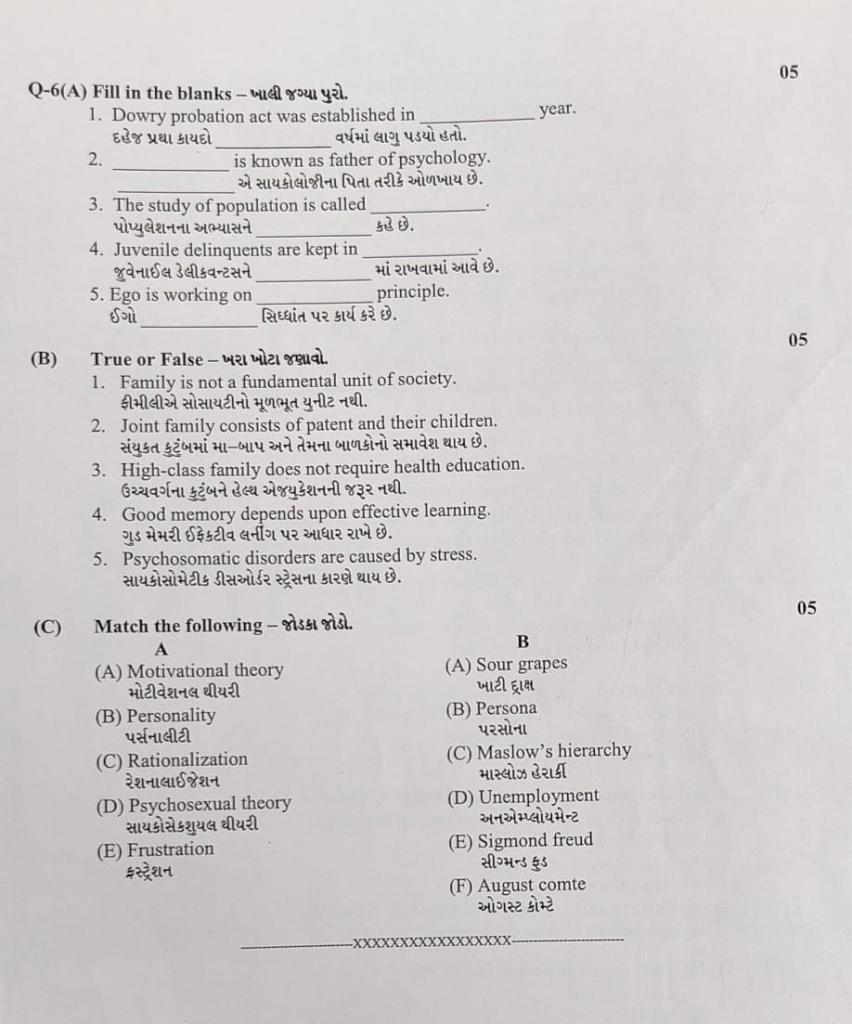
Q-6 (A) Fill in the blanks – Fill in the blanks. 05
1.Dowry probation act was established in …… Year. 1961 (Nineteen Sixty One)
2……. is known as father of psychology. …… is known as the father of psychology. Wilhelm Wundt
3.The study of population is called ……Demography
4.Juvenile delinquents are kept in …… Observation Home
5.Ego is working on …… principle. Reality Principle
(B) True or False – Tell me the truth. 05
1.Family is not a fundamental unit of society. Family is not the fundamental unit of society. False Correct Answer : Family is the fundamental unit of society.
2.Joint family consists of parent and their children. A joint family consists of parents and their children.False Correct Answer : A joint family consists of parents and children as well as grandparents, uncles and aunts and other relatives. A family consisting of only parents and children is called a nuclear family.
3.High-class family does not require health education. High-class family does not require health education. False Correct Answer : Health education is necessary for every class of people.
4.Good memory depends upon effective learning. Good memory depends upon effective learning. True
5.Psychosomatic disorders are caused by stress. Psychosomatic disorders are caused by stress. True
(C) Match the following – Jodka Jodka. 05
A B
(A) Motivational theory (A) Sour grapes
(B) Personality (B) Persona
(C) Rationalization (C) Maslow’s hierarchy
(D) Psychosexual theory (D) Unemployment
(E) Frustration (E) Sigmond freud
(F) August comte
Correct Answer :
(A) Motivational theory → (C) Maslow’s hierarchy
(B) Personality → (B) Persona
(C) Rationalization → (A) Sour grapes
(D) Psychosexual theory → (E) Sigmund Freud
(E) Frustration → (D) Unemployment
Correct Answer :
A – C
B – B
C – A
D – E
E – D